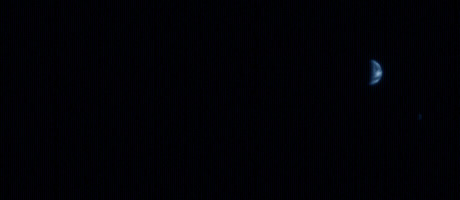
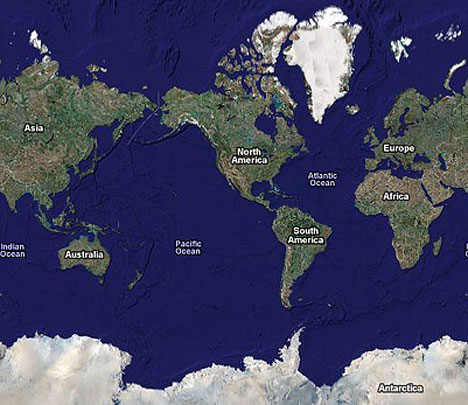
Dry Facts about Earth:
Location of Earth: Local Universe  Virgo Supercluster*
Local Group second-largest Galaxy** named "Milky Way"
the inner rim of the Orion Arm (Orion Spur) Solar
System 3rd
planet in distance outward from the local star, named Sun***
Virgo Supercluster*
Local Group second-largest Galaxy** named "Milky Way"
the inner rim of the Orion Arm (Orion Spur) Solar
System 3rd
planet in distance outward from the local star, named Sun***
Closest Galaxy to Milky Way is Canis Major dwarf Galaxy (distance: 25 000 ly), next in row is the Sagittarius dwarf galaxy.
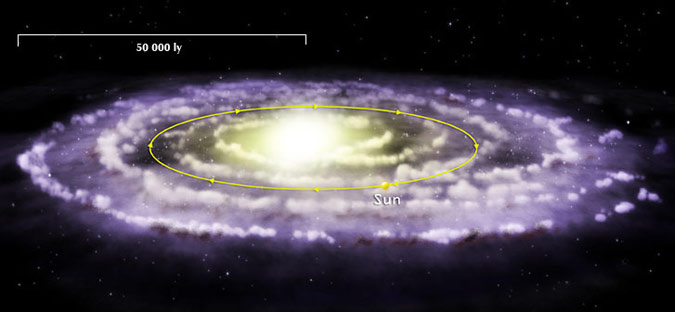
Solar System's orbit within Milky Way Galaxy. The sun is ONE of the estimated 200 to 400 billion (2x10^11 to 4x10^11) stars in this galaxy alone.
(image credit: NASA/CXC/M.Weiss)
The solar system travels in an orbit around the center of the Milky Way Galaxy at a velocity of a few hundred kilometers per second. So how long is a Solar System Year? Answer: even at that speed, completing one orbit, it takes the Solar System about 230 million standard years (Earth years).
The closest stars next to Sun are located in the Centaurus Constellation: Proxima
Centauri (Alpha Centauri C), Rigil Kentaurus (Alpha Centauri A), Alpha Centauri
B; all in a distance of about 4,3 ly.
Nearest planetary neighbors to Earth: Venus (average distance from Sun: 108 million
km, 0.7233 AU) and Mars (average distance from Sun: 217 million
km, 1.52 AU)
* Cluster = groups of galaxies held together by mutual gravitational attraction.
** Galaxy (translates literally "milky"), gets its name from a Greek myth about
Hera the Goddess of Heaven, who sprayed (by accident) her milk across the sky.
Romans: Via Lactea = "Road of Milk" derived from the Greek Galaxia (gala, galactos
means "milk" = Milky Way)
Milky Way: diameter about 100,000 ly, contains about 200-400 billion stars.
*** Earth's average distance from Sun: approximately 150 million km or 93 million
miles.
The mean distance between Earth and the Sun is also used to indicate distances
within a solar system, it is called Astronomical Unit,
1 AU = 149,597,870 km or 92,750,680 miles.
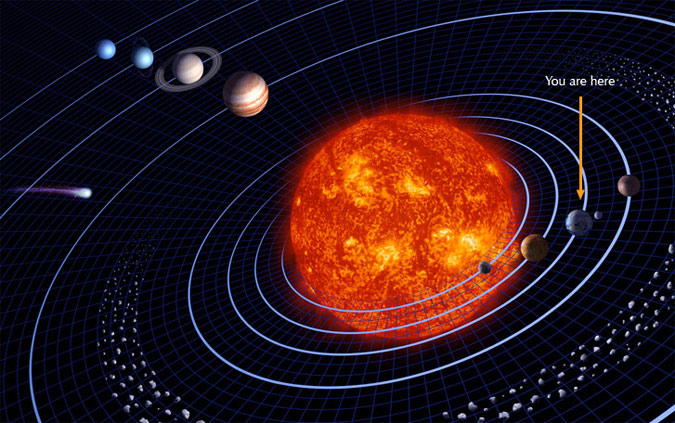
The main players in the Solar System are the Sun, the four terrestrial inner planets: Mercury, Venus, Earth, and Mars, the Inner Asteroid Belt (more than 10 million objects, whereof the dwarf planet Ceres is the largest and most massive body),
the four gas giant outer planets: Jupiter, Saturn, Uranus, and Neptune,
followed by the trans-Neptunian objects like the dwarf planets Pluto, Eris and Sedna and cubewanos, objects of the Kuiper belt.
Name:
Earth is (beside Sedna) the only planet in the solar system, whose name is not
derived from the Greek or Roman mythology, the origin of the now used form of
naming comes from the Anglo-Saxon word Erda (Erdaz), which means ground, soil,
and Earth, the word changed to Eorthe or Erthe in Old English and to Erde in German.
8th Century, in Old High German: erda, al therda, from OHG al th[iu] erda
'der gesamte Erdkreis', (meaning: hole world, earth)
Latin: Terra, Norwegian: Jord(n), Icelandic: jarðar (jardar), Aramaic: Ereds, Arabic: أرض (ard), Hebrew: Eretz,
Greek: ἔρα (era).
Asian names for Earth:
Chinese: 地球 (Dìqiú); Japanese: 地球 (Chikyū); Korean: 지구 (jigu); Hindi: पृथ्वी (Pr̥thvī); Malay and Indonesian: bumi; Thai: โลก (lok); Vietnamese: trái đất (try da).
 The
name of Earth in other languages The
name of Earth in other languages
Other names of Mother Earth
Earth goddesses: Hertha, Erda, Jörd, Fjörgyn, Hlödyn, Gaia, Tellus.
The Iroquois name for Mother Earth is Etenoha, the Lakota call her Ina Maka.
Age:
Planet Earth is made of stardust, born in the heat of a supernova together with
the sun and the other planets. They where formed by gravitational forces which
enable the process of the accretion of planetesimals that has originated the solar
planets; this happened about 4.5 to 4.8 billion years ago.
The Solar System's Big Bang
Shape:
More or less spherical.
Size:
Fact: the Earth is wider at the equator than from pole to pole, likely because
of its rotation - and - the equatorial circumference is growing, possible reasons are: the well-known centrifugal forces, and maybe some transfer
of mass from high to low latitudes (high latitude at the poles 90°, low latitude
at Earth's equator 0°) and/or a transfer of mass from the Earth's core (the
nucleus) and its mantle to the crust.
Earth circumferences:
Equatorial circumference: 40 076 km (~ 24 902 miles).
Polar circumference: 40 005 km (~ 24 858 miles).
Diameter of the Earth:
Equatorial Radius: 6 378 km (~ 3 963 miles).
Polar Radius: 6 357 km (~ 3 950 miles).
Volume: V = 4/3  x
r3 = 1 086 781 292 542 cubic km or 260 732 699 457 miles3. x
r3 = 1 086 781 292 542 cubic km or 260 732 699 457 miles3.
Surface:
Total Surface Area: about 509 600 000 square km (197 000 000 square miles).
Area of land: 148 326 000 km2 (57 268 900 square miles), this are 29%
of the total surface of Planet Earth.
Area of water: 361 740 000 km2 (139 668 500 square miles), this are
71% of the total surface of the Earth.
97 percent is salt water and only 3 percent is fresh water.
Estimated Mass:
5.976 x1024 kg or roughly 6x10²¹ metric tons.
Substance:
Earth consists predominantly of Oxygen, Silicon, Aluminum, Iron, Calcium, Sodium,
Potassium, Magnesium, Nickel and Carbon.
Density:
Earth is the densest major body in the solar system.
Density of planet Earth is about 5.52 g/cm3 or 5 520 kg/m3.
Water, as you might know, has a density of 1000 kg/m3 at 3.98 degrees centigrade
and at one atmosphere of pressure.
Orbital Data:
Sidereal period (Time Earth needs to orbit the sun once)
365.256 days.
Rotation:
The daily rotation of the Earth, which causes the distinction between day and
night, has been used as the basis for time reckoning for thousands of years.
It takes 23.9345 hours for the Earth to rotate a complete revolution.

Earth's spin axis is not perpendicular, the axis is tilted 23,45°, this circumstance
causes the seasons, because Earth's surface changes its position relative to the
Sun and therefore the amount of heat delivered to the surface.
Velocity:
The Earth orbits the Sun at a speed of 29.79 km (18.51 miles) per second
or 107 870 km (67 027 miles) per hour.
Satellites:
besides a number of active and obsolete artificial satellites (communications,
broadcasting, meteorological, military kind) there are by now 5 known natural
satellites, which orbit is in a way connected with Earth.
 Moon Moon
possibly a "child" of Earth, born in a "big whack" in which a roving planetoid,
at least as large as Mars, slams into Earth, creating a debris cloud that later
coalesces into the moon. This happened approximately 50 million to 100 million years
after the solar system's came into existence.
Moon's equatorial radius: 1 738.1 km (~ 1 080 miles)
average distance from Earth: 384 000 km (~ 238 607 miles)
The Moon orbits Earth in 27.3217 days
The Asteroids
Asteroid 3753 Cruithne "Earth's second moon" - size: 5 km in diameter - more
info
Asteroid J002E3, a
new moon or space
junk?
Asteroid 1685 Toro, size: approximately 5 km in diameter
Asteroid 1998 UP1
Asteroid 2000 PH5
Planetary Ring System: No
Atmosphere:
Average Surface Pressure: 1014 millibars.
Surface Density: 1.217 kg/m3.
The air that you breathe (dry air):
Major: 78.084% Nitrogen (N2), 20.946% Oxygen (O2)
Minor (parts per million): Argon (Ar) - 9 340; Carbon Dioxide (CO2) 350; Neon
(Ne) 18.18; Helium (He) 5.24; CH4 1.7; Krypton (Kr) 1.14; Hydrogen (H2) 0.55.
Temperature:
Coldest temperature: Minus 89.2 °C (-128.5° F) in Vostok, Antarctica,
1983.
Highest temperature: 58°C (136.4° F) at Al'Aziziyah, Libya, on 13th
September 1922.
Highest Point on Surface:
Mount Everest (Latitude 27° 59' N - Longitude 86° 56' E ), revised elevation:
8850 meters (29,035 feet) above sea level.
Most precious element on Earth:
Beside a crystalline isometric polymorph of carbon (diamonds), the most precious element on earth is CLEAN water.
Intelligent Visitors from Outer Space:
Infrequently
Life on Planet Earth:
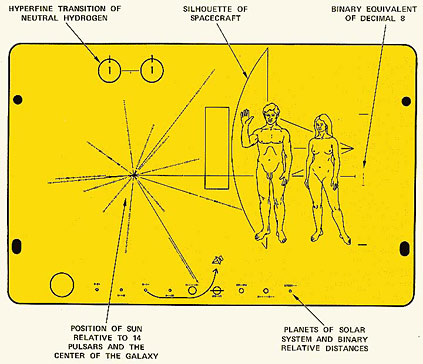 |
| Found on an antique space craft called Pioneer 10.
It shows an attempt of the human species of Earth to communicate with other civilizations in the universe.
The famed Pioneer plaque features a design engraved into a gold-anodized aluminum plate, 152 by 229 millimeters (6 by 9 inches), attached to the spacecraft's antenna support struts to help shield it from erosion by interstellar dust. The plaque was mounted on the Pioneer 10 and 11 spacecraft. |
Bookmark/share this page

|
Yes
Carbon-based life forms exists since 3.5 - 3.9 billion years,
including animals, plants, fungi, bacteria, and protists there may be over 30
million different species, the total number of animal species currently known
is 1.5 million.
The life-form with the most influence on modifications on Earth is a sub-species of a hominid family of primates, originally living near coastlines and river banks (after they came down from the trees). It's a relative old order of mammals, with an approximate age of 4.3 million years. This on hind limbs walking members of Homo sapiens sapiens, also known as the human race or mankind, originated most likely from the hot heart of the African continent. Meanwhile this species has spread all over the planet -- some call this success.
It is presumed that the anatomically modern humans (AMH) have evolved from an archaic Homo sapiens in the Middle Paleolithic (better known as Stone Age), about 200.000 years ago.
Therefore we have a closer look at this species:
Human Communication
 Language Language
The fundamental communication system of the human race is based on acoustic as
well as kinesic signals, the spoken language and body language).
The nonverbal communication of human body signals is, in general, until now underestimated
and has not been categorized very well.
On the other hand, the human acoustic signal systems can be divided in more than
6,900 different languages (by traditions coherent acoustic signal systems).
They are used by the various members of cultural human groups for their communication to express feelings, thoughts and the exchange of knowledge and experience.
About one-third of this languages have writing systems (symbolical pictorial signs
of a language; storable and/or for carry away), the others are only spoken (sound
generated). Since the beginning of Homo sapiens, new languages have been constantly
emerging while others vanished forever.
Since at least 30,000 years this species has developed additional forms of communication,
like paintings, sculptures and carving as well as some kind of melodious acoustic
signals based on rhythm and harmony--they call it music.
Little is known about telepathic communication on Earth.
Population:
Today there are more than 7 billion human beings, descendants of the Homo sapiens
sapiens.
See also:
The Global Village, a Summary of the World
Earth as a village of 100 people.
Largest Urban Agglomerations:
see the list of Most Populated Cities in the World.
Most Famous Landmarks
Most famous landmarks and monuments on Earth.
Earth Government:
There is no global government for Earth.
The organization of sovereign nations, the
United Nations - abbreviated by the acronym UN, with its humanitarian, peacekeeping and development tasks, its powerful Security Council and the not so powerful factions and fractions of the rest of all the countries might once play this role.
Meanwhile the power is divided among the
USA, China, European Countries, Russia, India, and the rest of the Independent States, and multinational companies, global rating agencies, international bank consortiums, greedy speculators, insurance companies, and political as well as religious interest groups, and if one believes in some conspiracy theories, an enlightenment-era secret society called the Illuminati controls them all.
Constitution of Earth:
There is no Constitution of Earth.
As a good basis for a future draft would be
the
Universal Declaration of Human Rights.
There is a draft of the
World Constitution
and Parliament Association:
"A Constitution for the Federation of Earth" as amended at the World Constituent Assembly in Troia, Portugal 1991.
Flag of the world:
There is no official flag of the Earth.
Symbol:

Earth sign, the symbol for the Earth.
World Time:
Today on Earth time measurement is based on the rotation of Earth on its axis
with respect to the stars (Universal Time - UT).
The
basis of Universal Time
is the mean sidereal time as measured on the Greenwich (England) initial or prime
meridian (longitude zero) counted from 0 hours at midnight.
UT which is the basis for the worldwide system of civil time, refers to a high
precision time scale called "Coordinated Universal Time" (abbreviated UTC), which
is accurate to approximately a nanosecond (billionth of a second) per day.
Local time of Earth's 24 time zones is given as an integral number of hours offset
from UTC.
e.g.: Central European Time (CET) = UTC +1h
Atlantic Standard Time = UTC -4h
Actual Coordinated Universal Time (UTC):
Friday-April-19 11:02
Continents:
(larger continuous masses of land)
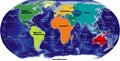
Number of Continents: 5-7, namely:
Africa, Asia, Australia North America, South America, Antarctica, Europe, and Oceania,
(North America and South America are often considered a single continent, America.
Europe and Asia are sometimes considered a single continent, Eurasia. Oceania comprises sometimes the landmass of Australia and all the scattered islands in the South Pacific)
Map
of Continents of the World
Worlds within the World?
The First, the Second, and the Third World.
A Three World Model?
Planet Earth Maps
Representation of Earth:
Political Map of the World
World map showing independent states borders, dependencies or areas of special
sovereignty, islands and island groups as well as capital cities.
Physical Map of the World
Shaded relief map of the world, showing landmasses, continents, oceans, regions, mountain ranges, islands and island groups as well as extreme points.
Planet
Earth
Outline map of the World.
More
Maps
Find more maps of planet Earth.
|

 Earth
Earth