More about Kyrgyzstan
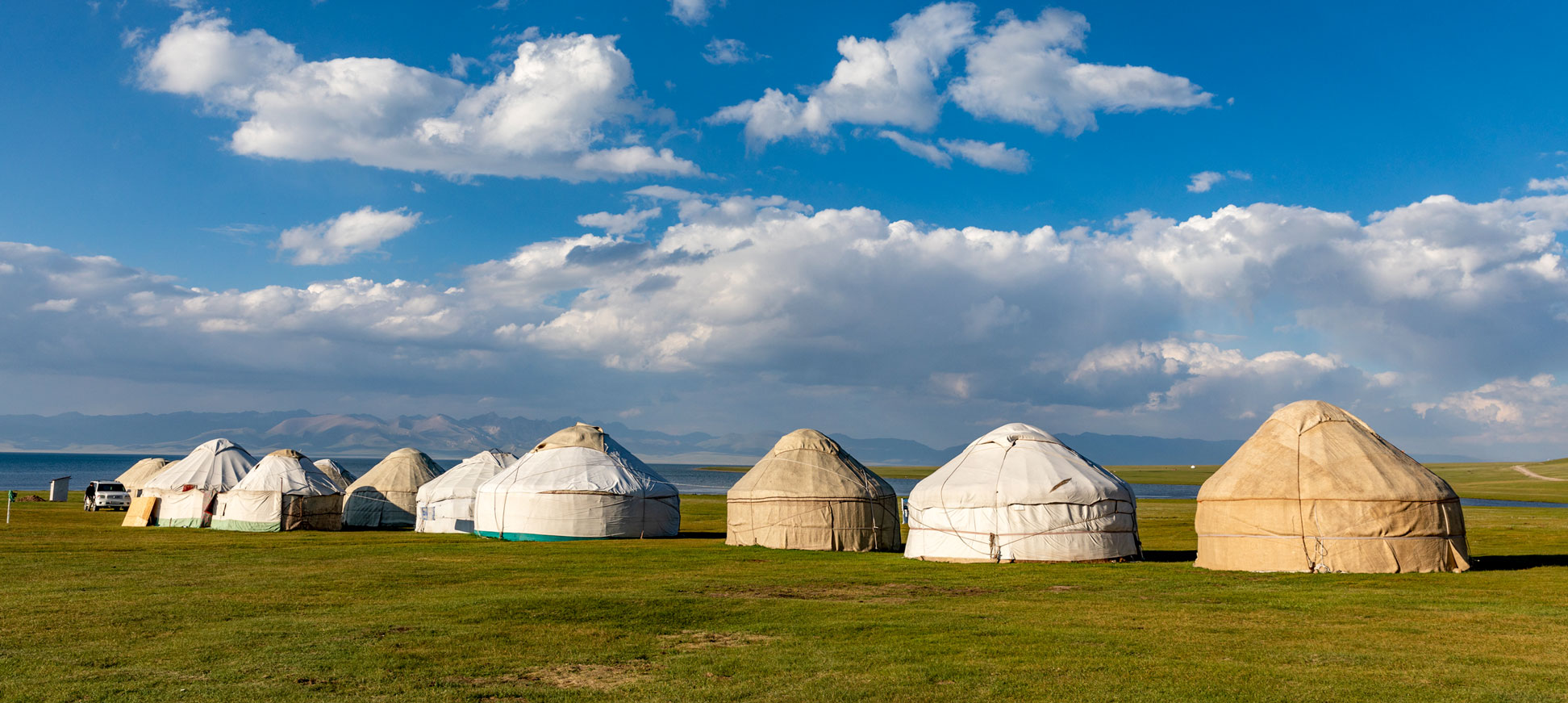
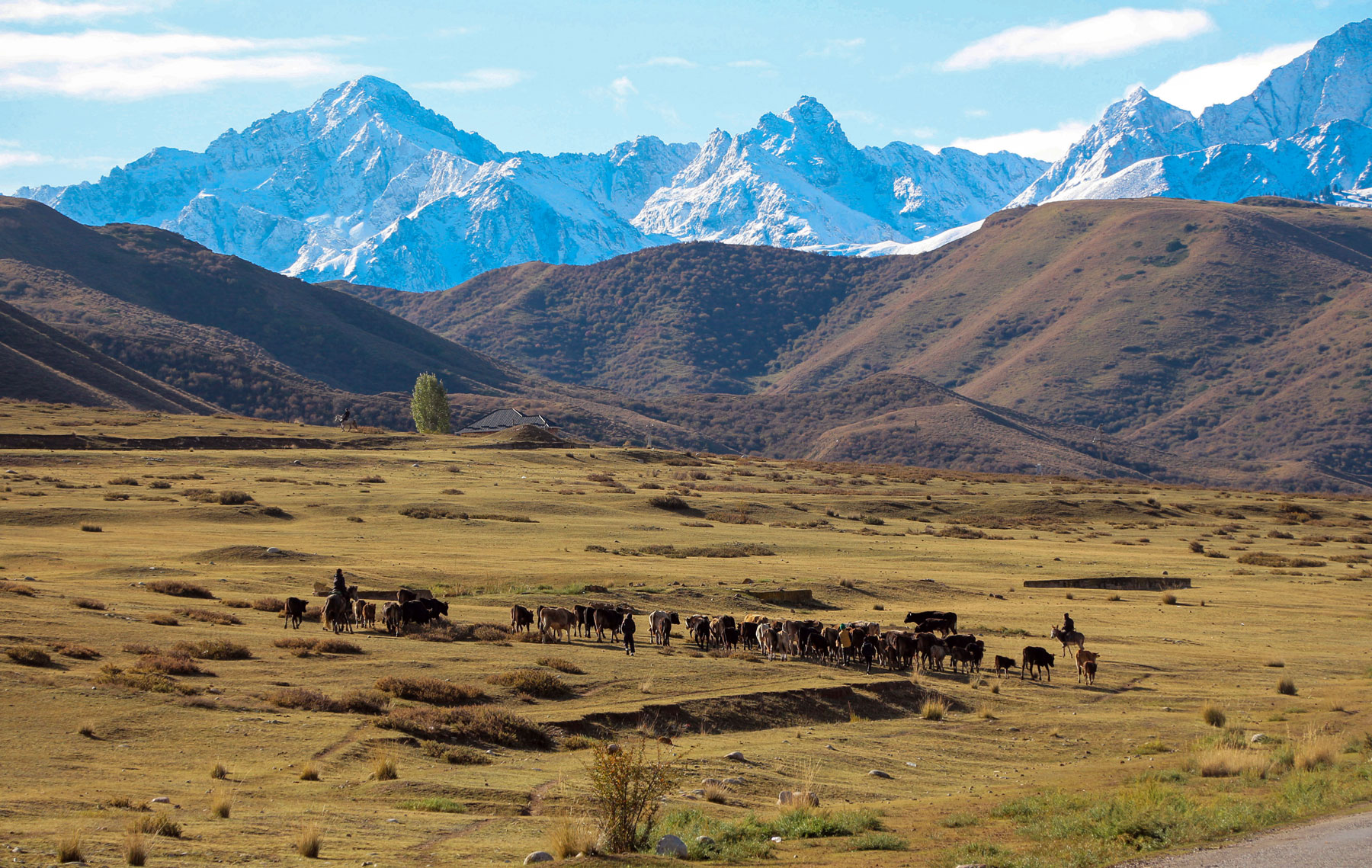 Livestock farming in the Issyk-Kul Region in north-eastern Kyrgyzstan, near the city of Karakol. The Tian Shan mountain range in the background. Like other Central Asian peoples, the Kyrgyz traditionally lived as nomads and shepherds, moving around with their herds of cattle and sheep in search of grazing land.
Photo: Bgag
Livestock farming in the Issyk-Kul Region in north-eastern Kyrgyzstan, near the city of Karakol. The Tian Shan mountain range in the background. Like other Central Asian peoples, the Kyrgyz traditionally lived as nomads and shepherds, moving around with their herds of cattle and sheep in search of grazing land.
Photo: Bgag
Kyrgyzstan, officially the
Kyrgyz Republic, is a mountainous country in eastern
Central Asia. The
Tian Shan and
Pamir mountain ranges dominate its landscape. The country features snow-capped peaks,
alpine lakes, and
high-altitude summer pastures known as
jailoo.
The region was crossed by key routes of the
Silk Road, linking traders and travelers between China,
Persia, and the
Mediterranean. The country's cultural heritage reflects a long tradition of nomadic life shaped by the rhythms of the land and the seasons.
The country became
independent from the
Soviet Union in 1991 and it joined the United Nations in 1992. It is a member of regional alliances such as the
CIS (Commonwealth of Independent States), the
Eurasian Economic Union (EAEU), and the Shanghai Cooperation Organisation (SCO).
The political system of Kyrgyzstan has, since independence, undergone several transformations. Today, it is formally a unitary presidential republic with one legislative house, the
Jogorku Kenesh (Supreme Council).
Major geographic features of Kyrgyzstan.
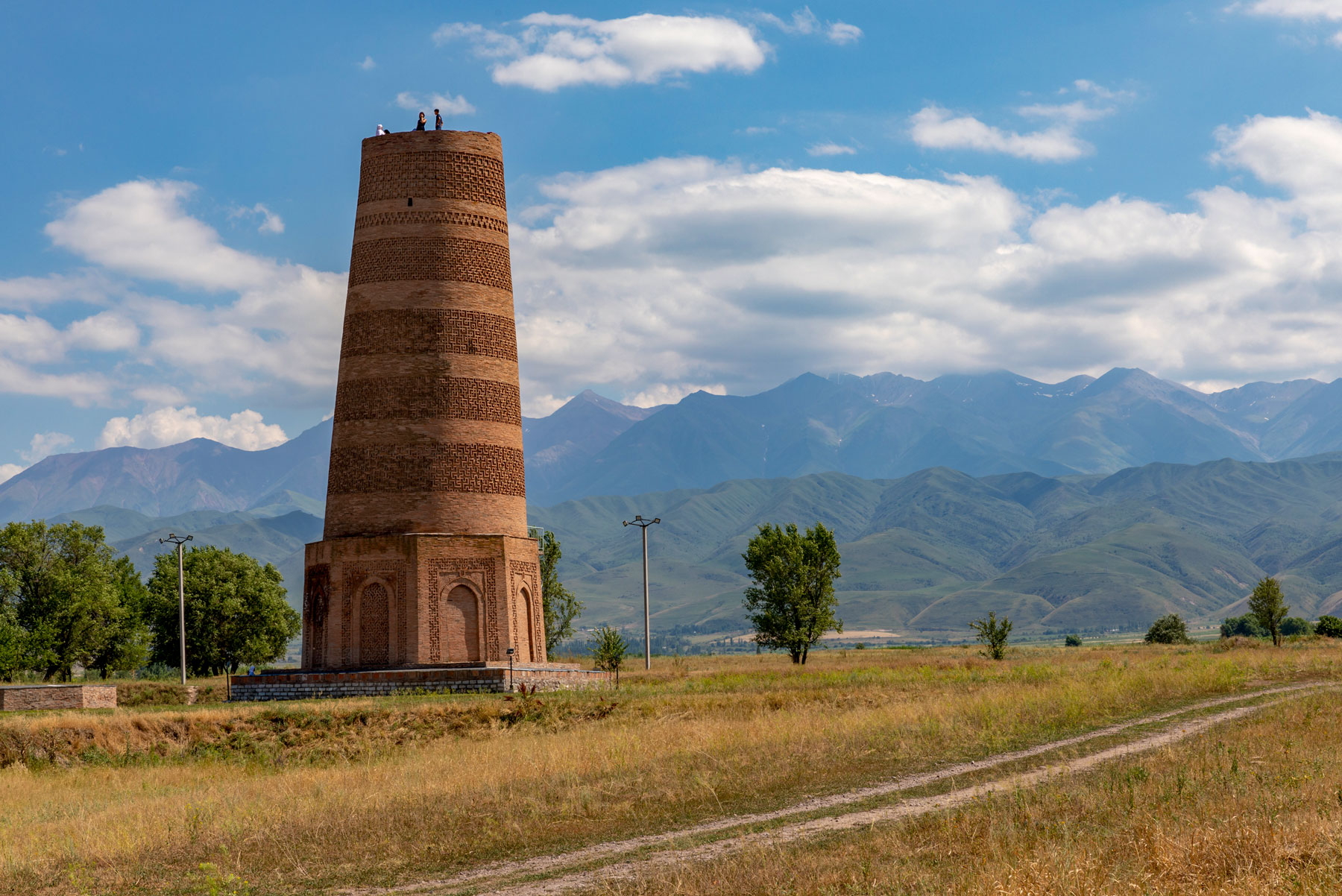 The Burana Tower in the Chüy Valley in northern Kyrgyzstan is a tall minaret built in the 11th century. The tower is one of the few remnants of the old town of Balasagun. Scattered around the tower are anthropomorphic stone steles known as balbals or kurgan steles.
Photo: Ninara
The Burana Tower in the Chüy Valley in northern Kyrgyzstan is a tall minaret built in the 11th century. The tower is one of the few remnants of the old town of Balasagun. Scattered around the tower are anthropomorphic stone steles known as balbals or kurgan steles.
Photo: Ninara
- The Tian Shan range, the "Mountains of Heaven," covers over 80% of the country.
- The Kyrgyz Ala-Too Range and Fergana Range are key subranges.
- The Tien Shan is home to Jengish Chokusu (Victory Peak) – at 7,439 m, the highest point in Kyrgyzstan.
Trans-Alay Mountains (Pamir)
The Trans-Alay Range is the northernmost range of the
Pamir Mountain System. It forms a prominent border between Kyrgyzstan and Tajikistan in the south. The alpine mountain range is remote and dotted with glaciers and deep valleys.
At 7,134 m,
Lenin Peak, on the Kyrgyzstan–Tajikistan border, is the highest mountain in the Trans-Alay Range. The mountain is also the second highest peak in both countries.
Lakes
Issyk-Kul
In the northeast of the country, surrounded by the Tian Shan mountains, lies Issyk-Kul, an
endorheic (no outlet) saltwater lake.
- The 182-kilometer (113 mi) long and up to 60-kilometer (37 mi) wide Issyk-Kul is the second-largest saline lake in the world. It is also the second-largest mountain lake after Lake Titicaca in the Andes Mountains.
- Due to its high salinity, the lake never freezes, despite its high altitude of 1,607 m.
- The lake is a major cultural and ecological landmark, ringed by snow-capped peaks of the Tian Shan.
Toktogul Lake
The Toktogul Lake is located on the
Naryn River, a northern tributary of the
Syr Darya. The Toktogul is a large artificial reservoir, the largest in Central Asia. The Toktogul Dam was built in the 1960s to store water for hydroelectric power generation and irrigation.
 A traditional golden eagle hunter in the foothills of the Tien Shan Mountains.
Photo: Maureen Barlin
A traditional golden eagle hunter in the foothills of the Tien Shan Mountains.
Photo: Maureen Barlin
The Fergana Valley spans eastern Uzbekistan, southern Kyrgyzstan, and northern Tajikistan. This fertile region is characterized by ethnic diversity. Various ethnic groups, including
Uzbeks,
Kyrgyz, and
Tajiks, share the valley. The valley is a maze of enclaves, disputed borders, and restricted freedom of movement. That has contributed to tensions among the local ethnic groups. Disputes over border demarcation and access to resources further exacerbate these challenges.
Kyrgyzstan Attractions
Ala Archa National Park
Ala Archa is an
alpine national park in the
Tian Shan mountains, named after the river Ala-Archa. The nature park is located a few kilometers south of the capital Bishkek.
Arslanbob
Arslanbob is the name of a village and a large nearby forest of wild walnut (Juglans regia); it is one of the largest walnut forests in the world. Arslanbob's groves produce between 1,000 and 1,500 tonnes of walnuts each year.
[BBC]
Tash Rabat
Tash Rabat is a well-preserved stone
caravanserai from the 15th century in the At-Bashy district of the Kyrgyz province of Naryn. The ancient caravan stop on the
Silk Road lies at an altitude of 3,200 meters.
Kyrgyz Cities
Kyrgyzstan's largest cities.
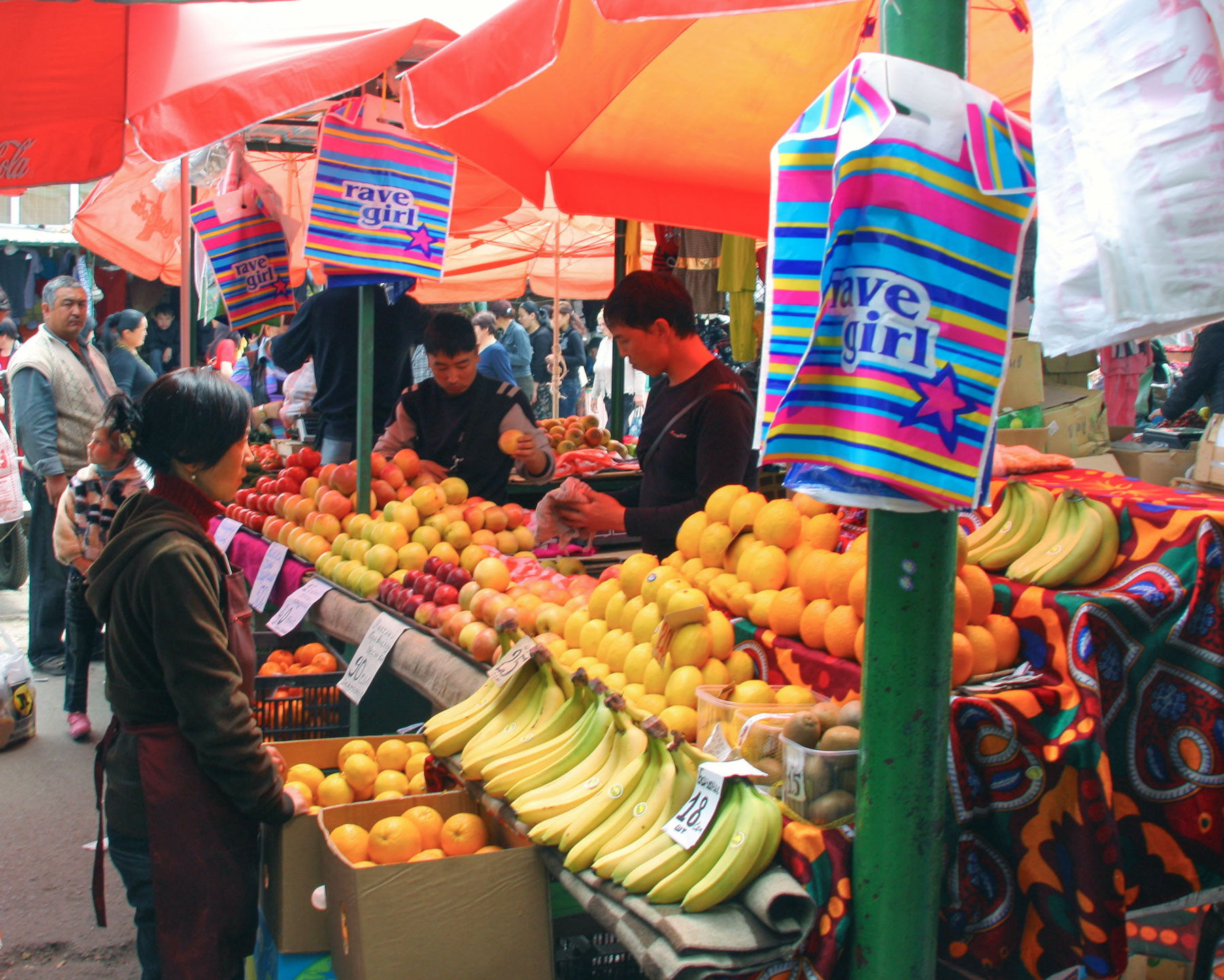 The Osh Bazaar in Bishkek is one of the largest bazaars in Kyrgyzstan. The market is located in the west of the city, near the western bus station.
Photo: neiljs
The Osh Bazaar in Bishkek is one of the largest bazaars in Kyrgyzstan. The market is located in the west of the city, near the western bus station.
Photo: neiljs
The capital and largest city of Kyrgyzstan is located in the northern part of the country, near the Kazakh-Kyrgyz border. The city has more than one million inhabitants. Bishkek is the country's political, economic, and cultural center. The city was once a caravan stop on the Silk Road. Bishkek, formerly
Frunze (1926–1991), grew significantly during the Soviet era. The city features wide boulevards, Soviet-style architecture, and leafy parks.
Osh
The oldest and second-largest city in the country is located in the Fergana Valley. It is often referred to as the "southern capital." Osh is one of Central Asia's oldest cities, with over 3,000 years of history. The town lies along the ancient Silk Road and is home to the
Sulaiman-Too Sacred Mountain, a UNESCO World Heritage site. The site is considered the most complete example of a
sacred mountain in Central Asia that has been worshipped for several millennia.
Jalal-Abad
The third largest city in Kyrgyzstan is the capital of the administrative region of the same name. Located at the edge of the fertile
Fergana Valley, Jalal-Abad is a major agricultural trade hub in southwestern Kyrgyzstan. The town is known for its mineral springs and access to the nearby
Arslanbob walnut forest, one of the largest natural walnut forests in the world.
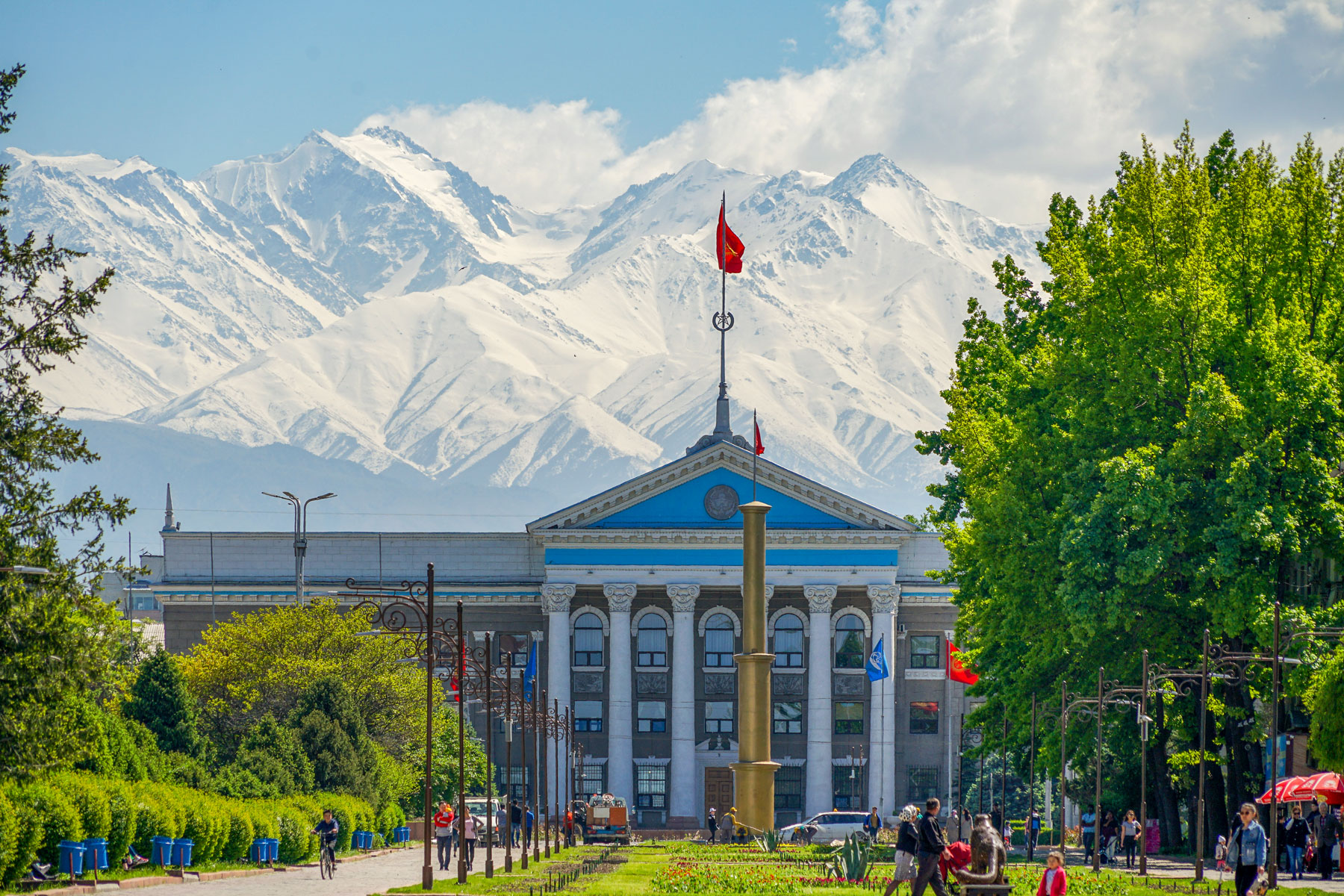 The City Hall in Bishkek, Kyrgyzstan's capital city. In the background are mountains of the Ala-Too mountain range, an extension of the Tian Shan mountains.
Photo: Kalpak Travel
The City Hall in Bishkek, Kyrgyzstan's capital city. In the background are mountains of the Ala-Too mountain range, an extension of the Tian Shan mountains.
Photo: Kalpak Travel
The town lies near the eastern tip of
Lake Issyk-Kul at the foot of the
Terskey Alatau Mountains. It is the administrative capital of the
Issyk-Kul Region. Karakol is popular with adventure tourists. It is a gateway to the
Tian Shan Mountains and a base for trekking, skiing, and mountaineering.
Tokmok
Tokmok is an industrial city near the Kazakh border; the city was once an important regional center during the Soviet era. It's close to the
Burana Tower, a minaret that is part of the ruins of the ancient city of
Balasagun.
Naryn
Naryn is located in a deep valley at a high altitude. It is a quiet city with a strong connection to
Kyrgyz traditions. The town is a center for nomadic culture and also hosts a campus of the
University of Central Asia  Talas
Talas
Talas is a small city nestled in the Talas Valley. The town is historically significant as the site where, in 751 AD, the
Battle of Talas took place. The battle was a military confrontation between the
Abbasid Caliphate and the
Tang Dynasty of China. Today, the town is an agricultural center with strong historical roots.




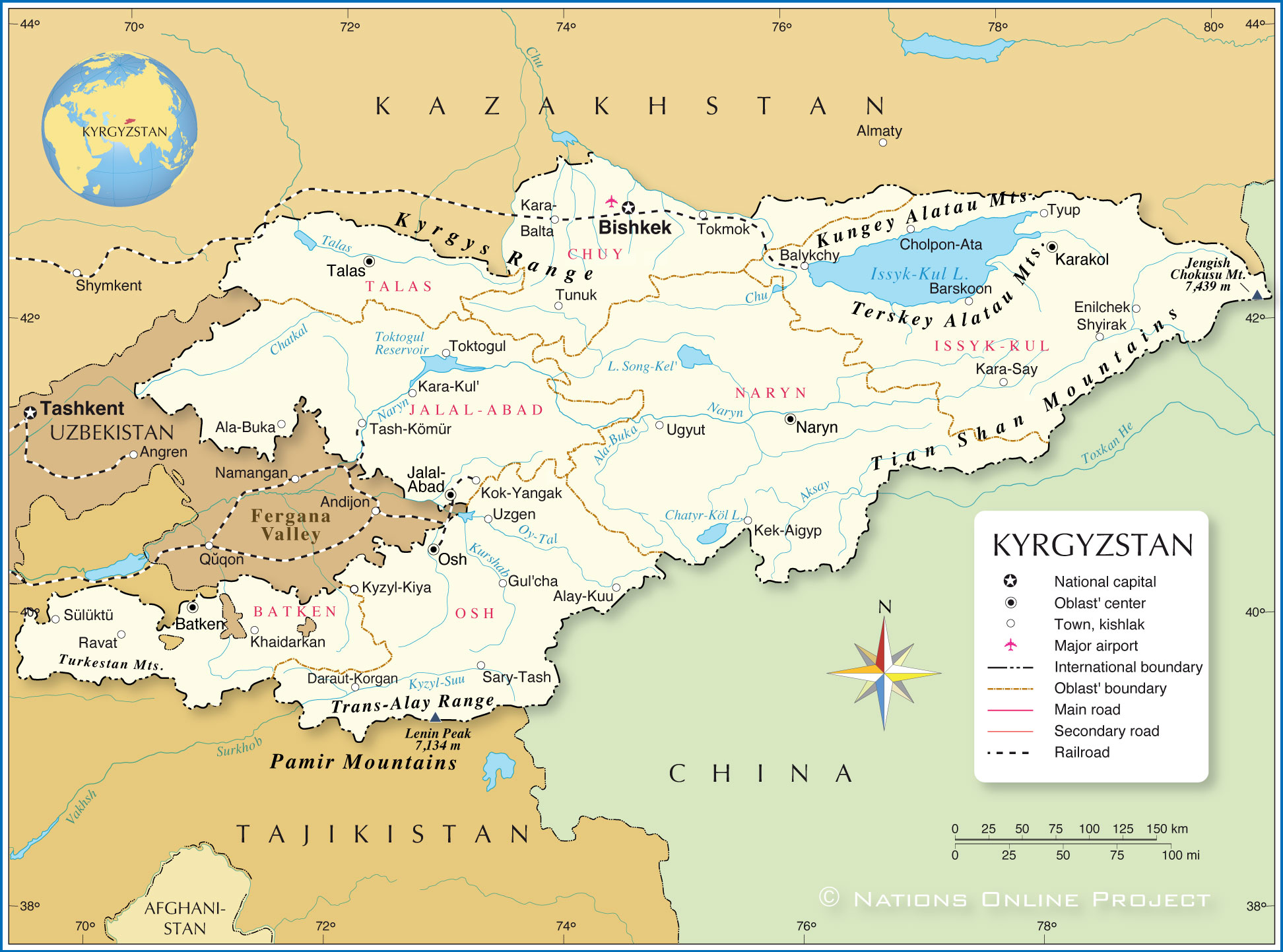
 You are free to use the above map for educational and similar purposes; if publishing, please credit Nations Online Project as the source.


