About Pakistan
Pakistan – Gateway Between South and Central Asia
The map shows Pakistan, a South Asian country located in the northwestern part of the Indian subcontinent. It shares borders with
India to the east,
Afghanistan and
Iran to the west, and
China to the northeast. To the south, Pakistan has over 1,000 kilometers of coastline along the
Arabian Sea.
In the far north lies
Gilgit-Baltistan, the country's northernmost region, part of the broader
Kashmir territory. A region disputed between India and Pakistan since the 1947 partition of
British India. This area is home to some of the world's highest peaks, including
Nanga Parbat (8,126 m) and
K2 (8,611 m), the second-highest mountain on Earth. The towering ranges of the
Himalayas and
Karakoram dominate the northern landscape.
Pakistan covers an
area of 796,095 km², making it slightly larger than
Turkey and nearly twice the size of
California.
Pakistan has a
population of more than 250 million people (in 2025). The
Islamic Republic of Pakistan, the country's official name, is the world's fifth-most populous nation, the
third-most populous country in Asia, and the
second-most populous Islamic country.
The federal capital is
Islamabad.
Karachi, the largest city, serves as the country's main port and economic powerhouse. Other major cities include
Lahore (the cultural capital), Faisalabad, Rawalpindi, Multan, Gujranwala, Hyderabad, Peshawar, and Quetta.
The official languages are Urdu and English, regional languages such as Punjabi, Sindhi, and Pashto are widely spoken.
Islam is the official religion, practiced by about 97% of the population—most of them Sunni Muslims.
More about Pakistan
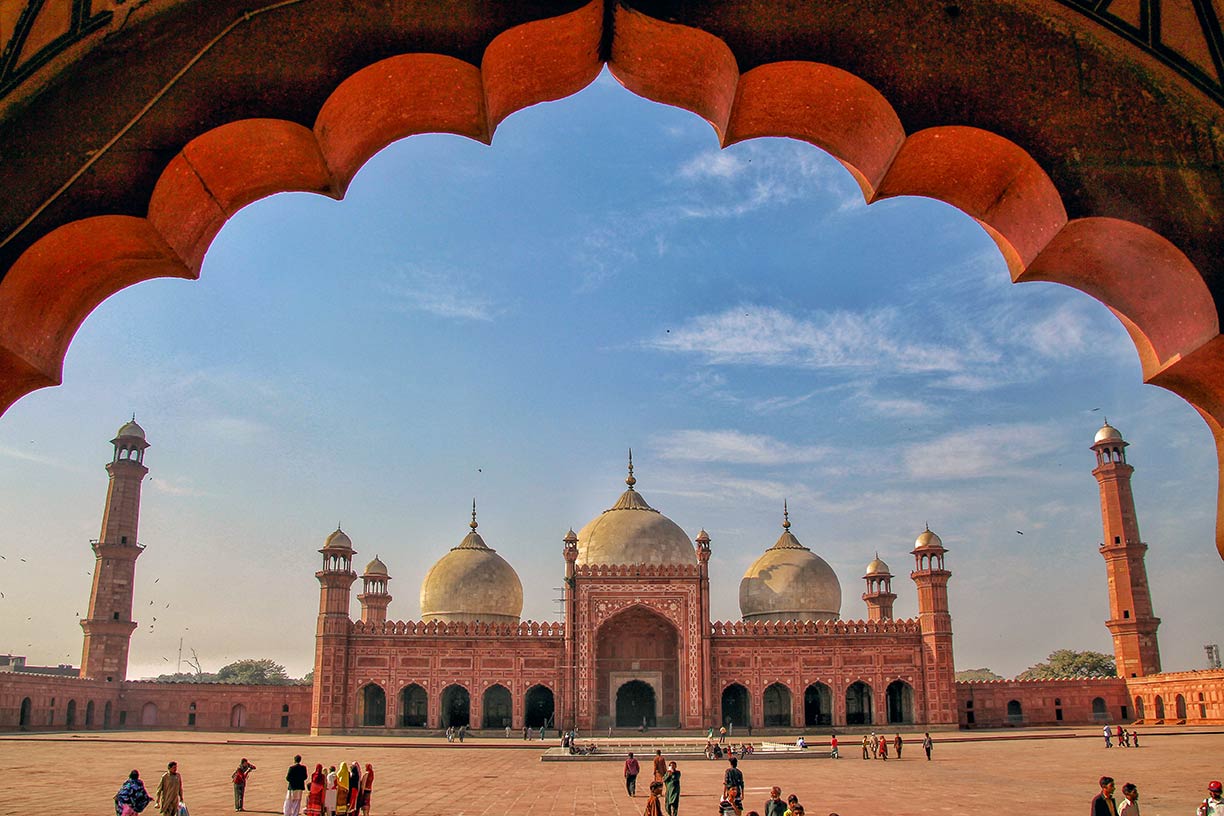 Mughal era Badshahi Mosque in Lahore, the capital of Punjab, Pakistan. The Badshahi Mosque, Lahore, is on UNESCO's tentative list of World Heritage Sites.
Photo: Fassifarooq
Pakistan was established on 14 August 1947 as a result of the partition of
British India. The country was created primarily to provide a separate homeland for Muslims in the Indian subcontinent, following rising demands for political and religious autonomy.
The movement for an independent Muslim state was led by the
All-India Muslim League under the leadership of
Muhammad Ali Jinnah, who would become Pakistan's founding father.
The Partition triggered the l
argest mass migration in recorded history, accompanied by widespread communal violence. Millions of Muslims moved to Pakistan, while Hindus and Sikhs migrated to India.
The name Pakistan means "
Land of the Pure" in Urdu. It also originated as an acronym from a 1933 pamphlet titled "Now or Never" by
Choudhry Rahmat Ali. In it, the term combined names of key regions: Punjab, Afghania (now Khyber Pakhtunkhwa), Kashmir, Sindh, and the suffix -stan from Balochistan.
At independence, Pakistan consisted of two geographically separate regions: West Pakistan (present-day Pakistan) and East Pakistan (now
Bangladesh), until the latter gained independence in 1971.
Geography of Pakistan
Pakistan stretches from the coastline of the Arabian Sea in the south to the towering peaks of the
Hindu Kush and
Karakoram ranges in the north. The country offers a variety of landscapes and climates: from fertile river plains and green valleys to arid deserts and snow-capped mountains. In the east, Pakistan shares the transboundary
Thar Desert with India, while the
Balochistan Plateau dominates the southwest with its dry climate and rugged terrain. In the far north, near
Skardu in Gilgit-Baltistan, lies the Katpana Desert, a rare high-altitude cold desert nestled in the Shigar District.
 The Katpana Desert, or Cold Desert, near Skardu in Gilgit-Baltistan. The high-altitude desert is one of the highest in the world.
Photo: Fassifarooq
Deserts
Pakistan is home to several distinct desert regions. The
Thar Desert, located along the country's eastern border with India, is one of the largest and most densely populated desert areas in the world. In the southwest, the
Balochistan Plateau features arid, mountainous terrain with sparse vegetation and harsh climatic conditions. In the north, near
Skardu in the Shigar District of Gilgit-Baltistan, lies the
Katpana Desert, a high-altitude cold desert. Also known as the
Cold Desert of Skardu, it is
one of the highest deserts in the world, with sand dunes set against a backdrop of snow-covered peaks.
Rivers and Plains
Pakistan's eastern terrain is characterized by the flat
Indus Plain (part of the larger Indo-Gangetic Plain), crossed by the
Indus River and its tributaries. The Indus is the country's primary river and an essential water resource, but it also can cause floods and mudflows. The
Indus River basin is crucial for Pakistan's agricultural economy, supporting the livelihoods of millions of people. The Indus River valley is known as the cradle of the ancient
Indus Valley Civilization, one of the world's earliest urban cultures, which flourished around 2500 BCE.
 The Indus River near Skardu in Gilgit-Baltistan, Pakistan. The city is an important gateway to the eight-thousand-meter peaks of the nearby Karakoram Mountains. The Indus River and its tributaries are the backbone of agriculture and food production in Pakistan.
Photo: Akhtar Bashir Nigyaal
The Indus River near Skardu in Gilgit-Baltistan, Pakistan. The city is an important gateway to the eight-thousand-meter peaks of the nearby Karakoram Mountains. The Indus River and its tributaries are the backbone of agriculture and food production in Pakistan.
Photo: Akhtar Bashir Nigyaal
Rivers of Pakistan
Pakistan's river system is dominated by the
Indus River, the country's primary water source and lifeline for agriculture. The Indus has its source on the Tibetan plateau, it flows from there through
Ladakh (India-administered) and later enters
Gilgit-Baltistan. The river travels southward through the length of Pakistan before reaching the
Arabian Sea. The Indus River Basin forms one of the most extensive irrigation systems in the world.
Major tributaries of the Indus include:
- Jhelum River – originates in the Indian-administered Kashmir Valley
- Chenab River – formed in Himachal Pradesh, flows into Punjab
- Ravi River – also rises in Himachal Pradesh
- Sutlej River – flows from Tibet through northern India into Pakistan
- Beas River – merges with the Sutlej (its waters do not reach Pakistan but are relevant under the Indus Waters Treaty)
These rivers sustain the Indus Plain, support agriculture, and are central to Pakistan's economy, culture, and history.
Indus River Delta
At the point where the Indus River meets the
Arabian Sea, it forms one of the
largest river deltas in the world. The Indus River Delta is a vast and ecologically rich region, home to extensive
mangrove forests that provide critical habitat for numerous bird species, fish, and other aquatic life. These mangroves play a vital role in stabilizing the coastline, acting as a natural buffer against storm surges, erosion, and sea-level rise. The delta includes the
Indus River Delta-Arabian Sea Wetland, which is internationally recognized under the Ramsar Convention for its ecological importance. Despite its significance, the Indus Delta faces serious environmental threats—from pollution, overfishing, and water diversion to mangrove deforestation, excessive use of agrochemicals, and the growing impacts of climate change.
 The Skardu Valley Delta lies within the Skardu Valley in Pakistan's Gilgit-Baltistan, where the Indus River is joined by glacial streams such as the Shigar River and Satpara Stream, forming a broad, braided floodplain..
Photo: Ruud
The Skardu Valley Delta lies within the Skardu Valley in Pakistan's Gilgit-Baltistan, where the Indus River is joined by glacial streams such as the Shigar River and Satpara Stream, forming a broad, braided floodplain..
Photo: Ruud
Lakes of Pakistan
Pakistan is home to numerous lakes, many of them located in mountainous regions:
- Manchar Lake – near Sehwan in Sindh, is Pakistan's largest freshwater lake.
- Keenjhar Lake (Kalri Lake) – another large freshwater lake, near Thatta in Sindh.
- Saiful Muluk Lake – a glacial alpine lake at 3,224 meters, in the Kaghan Valley.
- Attabad Lake – formed by a landslide in 2010 in Gilgit-Baltistan, now a scenic and popular destination.
- Shandur Lake – near the famous Shandur Pass, known for its high-altitude polo ground.
- Haleji Lake – an important bird sanctuary in Sindh.
- Rush Lake – one of the world's highest alpine lakes, at over 4,694 meters, near Rush Peak in the Karakoram.
- Naltar Lakes – four major alpine lakes in Naltar Valley at altitudes ranging from 3,050–3,150 m
These lakes are vital water resources for nearby communities.
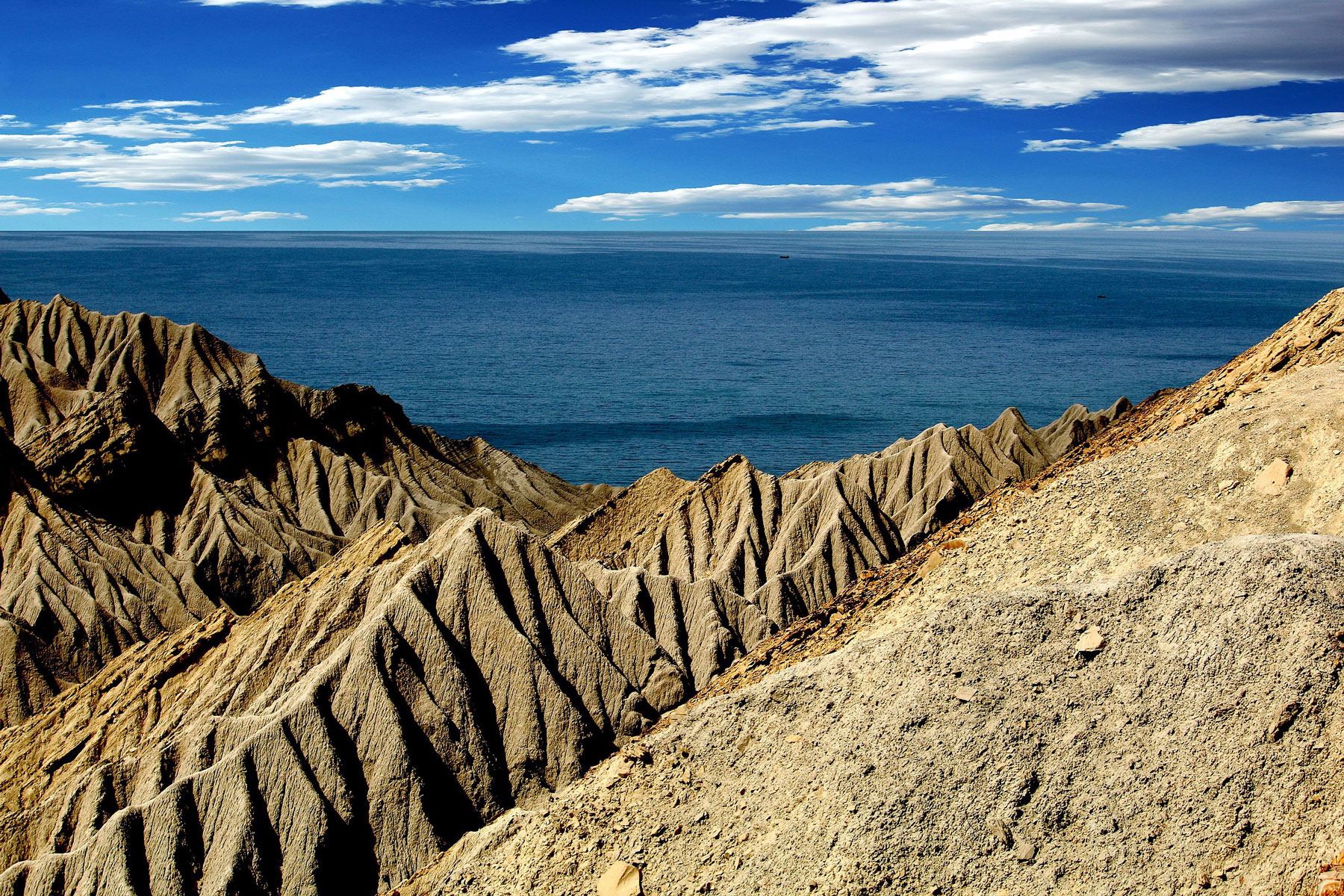 View of Pakistan's coastline near Ormara, a city in the district of Gwadar in the province of Balochistan in Pakistan. The port city in the coastal region of Makran is located 360 kilometers west of Karachi and 230 kilometers east of Gwadar on the Arabian Sea.
Photo: Akhtar Bashir Nigyaal
View of Pakistan's coastline near Ormara, a city in the district of Gwadar in the province of Balochistan in Pakistan. The port city in the coastal region of Makran is located 360 kilometers west of Karachi and 230 kilometers east of Gwadar on the Arabian Sea.
Photo: Akhtar Bashir Nigyaal
Pakistan's Coastline
Pakistan's southern frontier meets the
Arabian Sea, stretching over 1,000 kilometers. The coastline is crucial for the country's economy and ecology. At its heart lies Karachi, Pakistan's largest city and principal seaport is a major center for trade, industry, and finance. The coastal zone supports a vibrant fishing industry and includes ecologically rich areas such as mangrove forests, estuaries, and coral habitats. These coastal ecosystems are vital for marine biodiversity and serve as natural buffers against storms and erosion.
Mountain Ranges
North of the capital
Islamabad, Pakistan's terrain rises dramatically into some of the world's most spectacular mountain systems.
The landscape is shaped by the
Himalayas, the
Karakoram, and the
Hindu Kush ranges, which converge in the country's northern regions.
The highest peak in Pakistan is
K2, standing at 8,611 meters. It is the second-highest mountain on Earth after Mount Everest. Located in the
Karakoram range near the Pakistan–China border, K2 is also known by several names: Mount Godwin-Austen, Chhogori (or Qogir), and Ketu/Kechu.
 View from K2 to the Gasherbrum mountain range, a remote group of peaks situated at the northeastern end of the Baltoro Glacier in the Karakoram mountain range. The Siachen Glacier is on the left in the background.
Photo: Syed Hasan Shabbar
View from K2 to the Gasherbrum mountain range, a remote group of peaks situated at the northeastern end of the Baltoro Glacier in the Karakoram mountain range. The Siachen Glacier is on the left in the background.
Photo: Syed Hasan Shabbar
Pakistan is home to five of the world's 14 eight-thousanders—mountains that rise above 8,000 meters:
- K2 (8,611 m)
- Nanga Parbat (8,126 m) – in the western Himalayas
- Gasherbrum I (8,080 m)
- Broad Peak (8,051 m) - southeast from K2 and and northwest from the Gasherbrum peaks
- Gasherbrum II (8,035 m)
Beyond these giants, other important ranges include:
- The Sulaiman Mountains, part of the southern foothills of the Hindu Kush, extending into western Pakistan.
- The Siahan Range in central Balochistan, with peaks rising up to 2,000 meters and characterized by arid, rugged terrain.
These mountains not only define Pakistan's northern frontier but also influence its climate, rivers, and cultural diversity, making the region a key part of the country's physical and human geography.
Climate
Pakistan's climate varies widely due to its diverse topography. In the northern mountains, winters can be harsh and arctic-like, with heavy snowfall and sub-zero temperatures. In contrast, the southern coastal areas experience a tropical climate, with milder winters and humid summers. The country has four distinct seasons:
- Winter (December to February): Cool and dry, with colder conditions in the north.
- Spring (March to May): Hot and dry, with rising temperatures across the plains.
- Monsoon (June to September): The rainy season, bringing most of the annual precipitation, especially to the eastern and southern regions.
- Retreating Monsoon (October and November): Transitional, with declining rainfall and cooling temperatures.
These seasonal patterns shape agriculture, water availability, and daily life across the country. However, climate change is increasingly affecting rainfall patterns and extreme weather events.
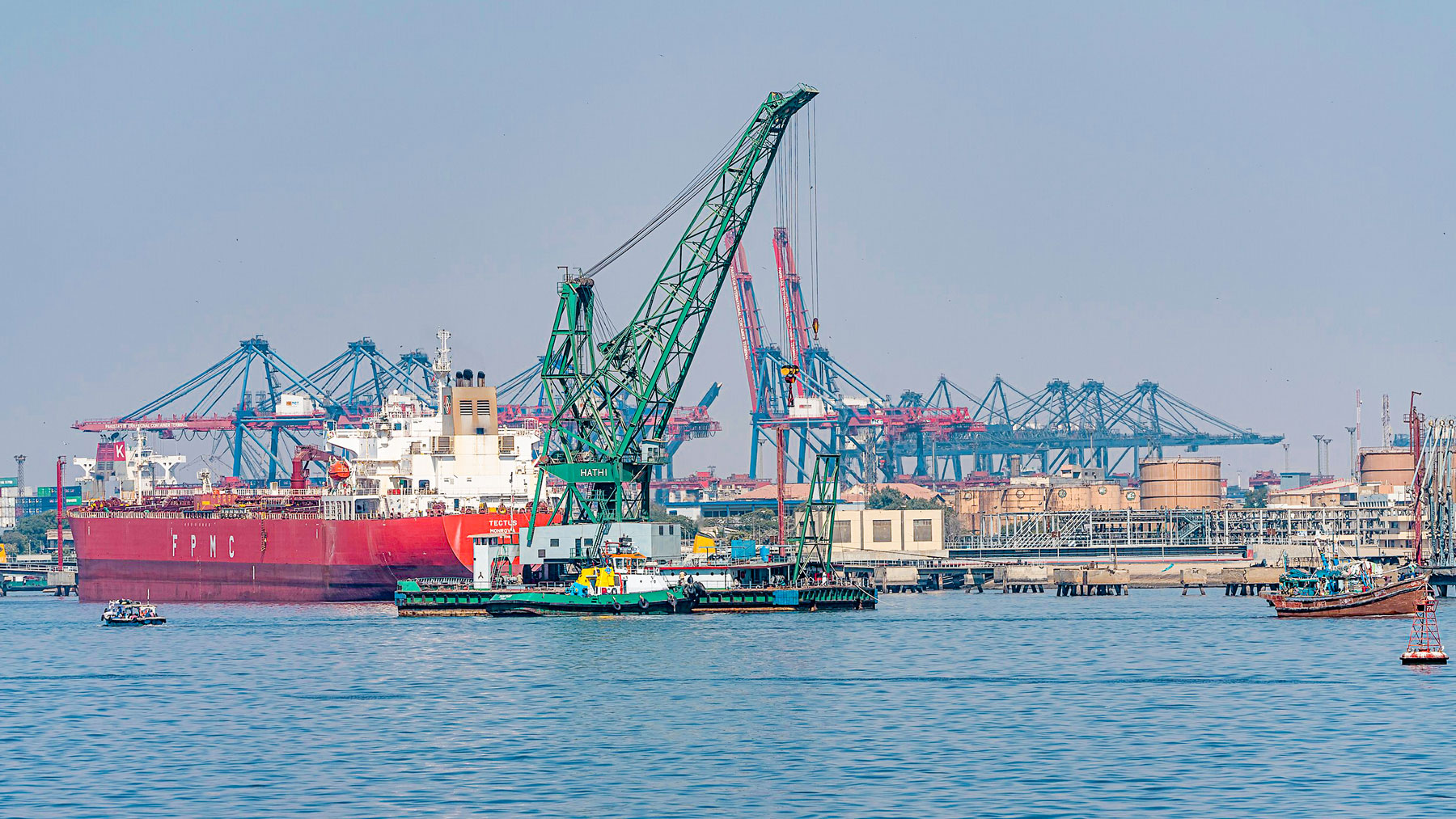 Oil port in Karachi, Pakistan's lartgest city and chiefport.
Photo: A.Savin
Oil port in Karachi, Pakistan's lartgest city and chiefport.
Photo: A.Savin
Transport
Pakistan's transport network includes railways, ports, and airports that connect the country's diverse regions—from mountainous terrain to coastal hubs.
Railways
Pakistan's railway system was primarily built during the
British Raj, beginning in 1855.
Railways Pakistan Railways (PR), headquartered in Lahore, operates a route network of nearly 7,800 kilometers. It connects major cities, towns, and regions across the country, offering passenger and freight services. The railway plays a vital role in domestic mobility and the transport of goods.
Ports in Pakistan
Pakistan's primary seaports are located along the Arabian Sea:
- Port of Karachi – the country's oldest and busiest port.
- Port Qasim – a major deep-water port southeast of Karachi.
- Gwadar Port – a strategic facility on the southwestern coast, central to China's Belt and Road Initiative and the China-Pakistan Economic Corridor (CPEC).
These ports are crucial for trade, energy imports, and regional connectivity.
Railways
Pakistan Railways (PR), based in Lahore, is the national state railroad company with a route network of almost 7800 km.
PR provides rail transportation across the country, connecting major cities, towns, and regions.
Ports in Pakistan
Pakistan's primary seaports are located along the Arabian Sea:
- Port of Karachi – the country's oldest and busiest port.
- Port Qasim – a major deep-water port southeast of Karachi.
- Gwadar Port – a strategic facility on the southwestern coast, central to China's Belt and Road Initiative and the China-Pakistan Economic Corridor (CPEC).
These ports are crucial for trade, energy imports, and regional connectivity.
Airports in Pakistan
Pakistan's major international airports serve as gateways for travel and commerce (IATA codes in brackets):
These airports link Pakistan to regional and global destinations.
Pakistan Civil Aviation Authority 
(PCAA) – New official website: pcaa.gov.pk
Pakistan Airports Authority (PAA) – New official website: paa.gov.pk


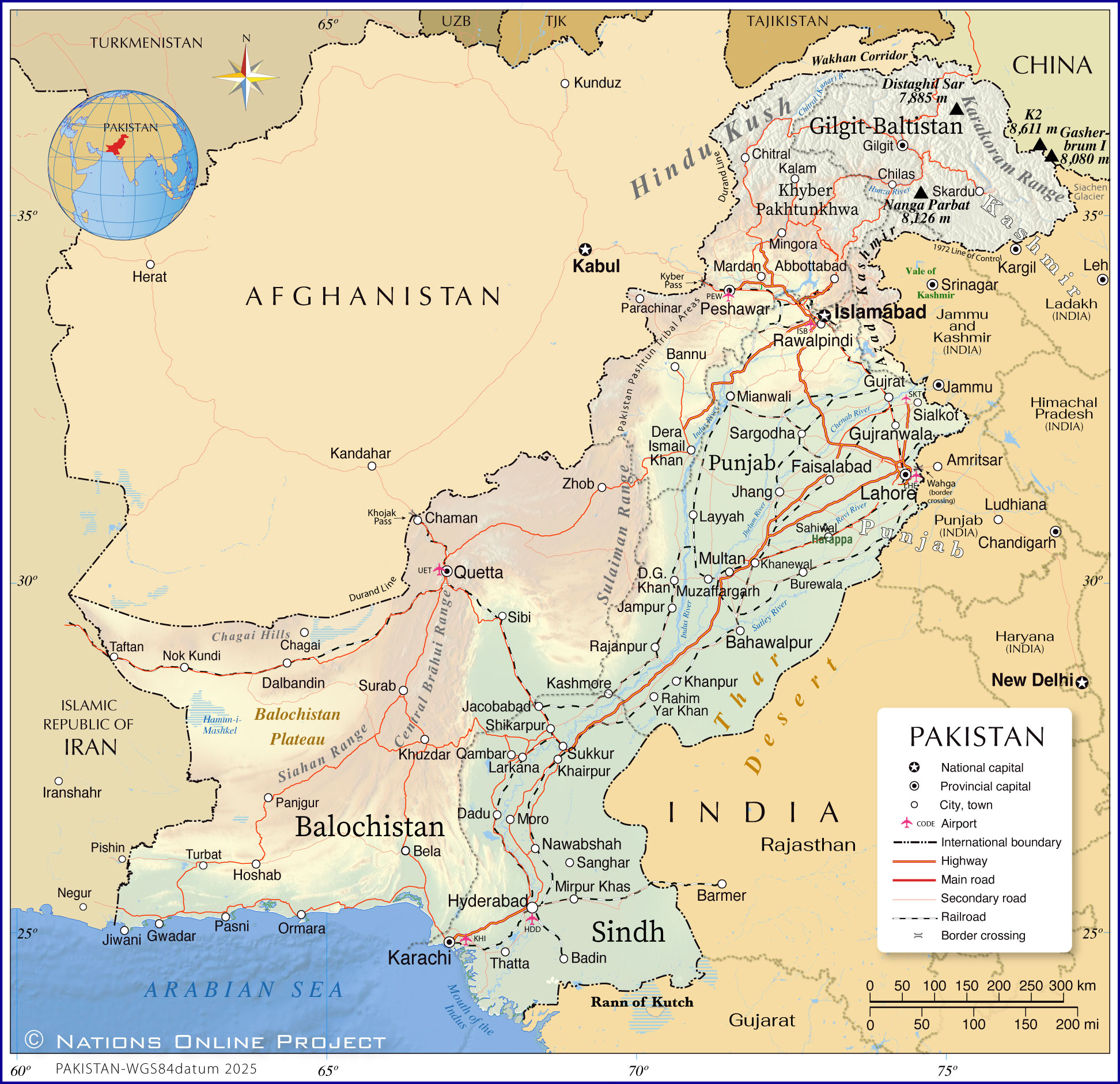
 You are free to use the above map for educational and non-profit purposes; if you publish it online or in print, you need to credit the Nations Online Project as the source.