-Island-in-Phang-Nga_Bay-Thailand.jpg "Phang Nga Bay Southern Thailand.") The Phang Nga Bay in the Andaman Sea in Southern Thailand. In the center is Thailand's probably most famous limestone rock, Ko Tapu (known as the needle in Thai). To the right is Khao Phing Kan island, together they are known as James Bond Island.
Photo: © Vyacheslav Argenberg
The Phang Nga Bay in the Andaman Sea in Southern Thailand. In the center is Thailand's probably most famous limestone rock, Ko Tapu (known as the needle in Thai). To the right is Khao Phing Kan island, together they are known as James Bond Island.
Photo: © Vyacheslav Argenberg
🏝 Thailand's Islands
Thailand is renowned for its numerous tropical islands, both in the
Gulf of Thailand and the
Andaman Sea. Many of the islands offer dramatic limestone cliffs, palm tree fringed pristine white-sand beaches, and crystal clear turquoise waters teeming with colorful fish.
Among the most popular and well-known islands are
Phuket,
Koh Samui,
Koh Phi Phi,
Koh Lipe, and
Koh Tao.
Phuket is Thailand's largest island and an important center for tourism, while
Koh Samui is known for its beautiful beaches and vibrant nightlife.
🟦 Andaman Sea (West Coast)
🏝
Phuket
Largest Thai island and a global tourist hub. It offers everything: beaches, nightlife, culture, and access to nearby islands. Patong Beach is infamous; Old Town Phuket is charming and historic.
🏝
Ko Phi Phi
World-famous for Maya Bay (The Beach movie). A postcard-perfect limestone island group with turquoise lagoons and vibrant coral reefs. No roads—just paths and longtail boats.
🏝
Ko Lanta
Much calmer than its neighbors. Long beaches, mangroves, and a laid-back vibe. Great for families and divers. Lanta Yai is the main island.
 The underwater world of the Similan Islands in the Andaman Sea, Thailand.
Photo: Neo Wu
The underwater world of the Similan Islands in the Andaman Sea, Thailand.
Photo: Neo Wu
🏝
Similan Islands (Mu Ko Similan National Park)
Considered one of the best diving spots in the world. Crystal-clear water, giant boulders, and healthy coral reefs. Protected and mostly uninhabited.
🏝
Ko Tarutao
Part of a marine national park near Malaysia. Wild, mysterious, and relatively untouched. Once a prison island, now a paradise for nature lovers.
🟦 Gulf of Thailand (East Coast)
🏝
Ko Samui
Ko Samui is the second-largest Thai island. Coconut palms, luxury resorts, waterfalls, and temples. Chaweng Beach is bustling; Lamai and Maenam are more relaxed. Samui Airport (USM) connects the island to domestic destinations by Bangkok Airways.
🏝
Ko Pha Ngan Known
Ko Pha Ngan is known for its
Full Moon Party, but also lush jungles, peaceful coves, and yoga retreats. Popular with backpackers and seekers of balance.
🏝
Ko Tao
Ko Tao is a diver's paradise. Compact, friendly, and surrounded by coral gardens. Also good for snorkeling, rock climbing, and enjoying sunsets with a cocktail.
🏝
Ko Chang
Ko Chang, the
Elephant Island; it is largest island in the Gulf of Thailand, near the Cambodian border. Rugged jungle interior, waterfalls, and a growing tourism scene. Part of
Mu Ko Chang National Park.
🏝
Ko Samet
Ko Samet is the closest island escape from Bangkok. Powdery white beaches and calm waters. Small but incredibly popular for weekenders and city-weary souls.
🟦 Rivers of Thailand
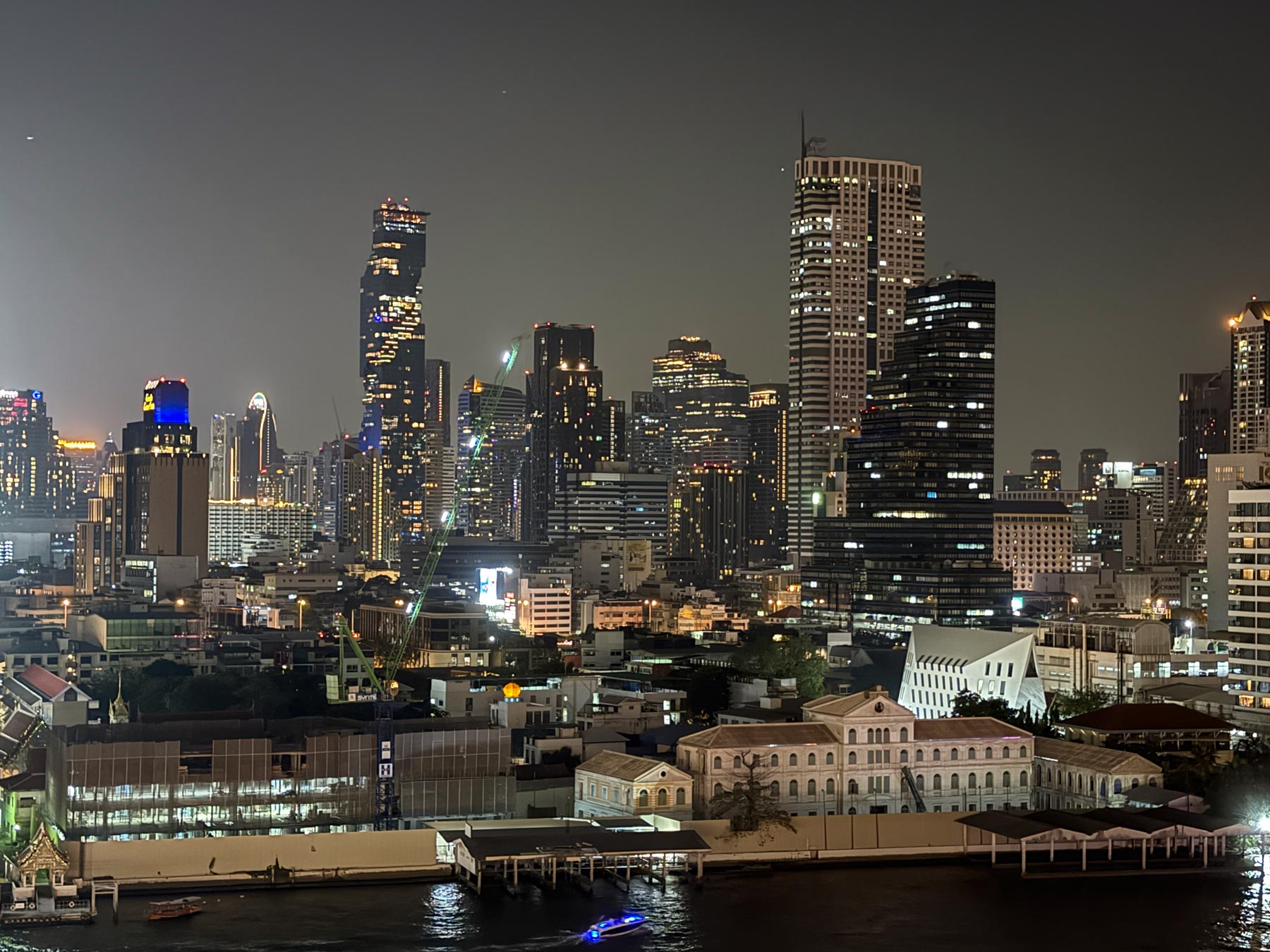
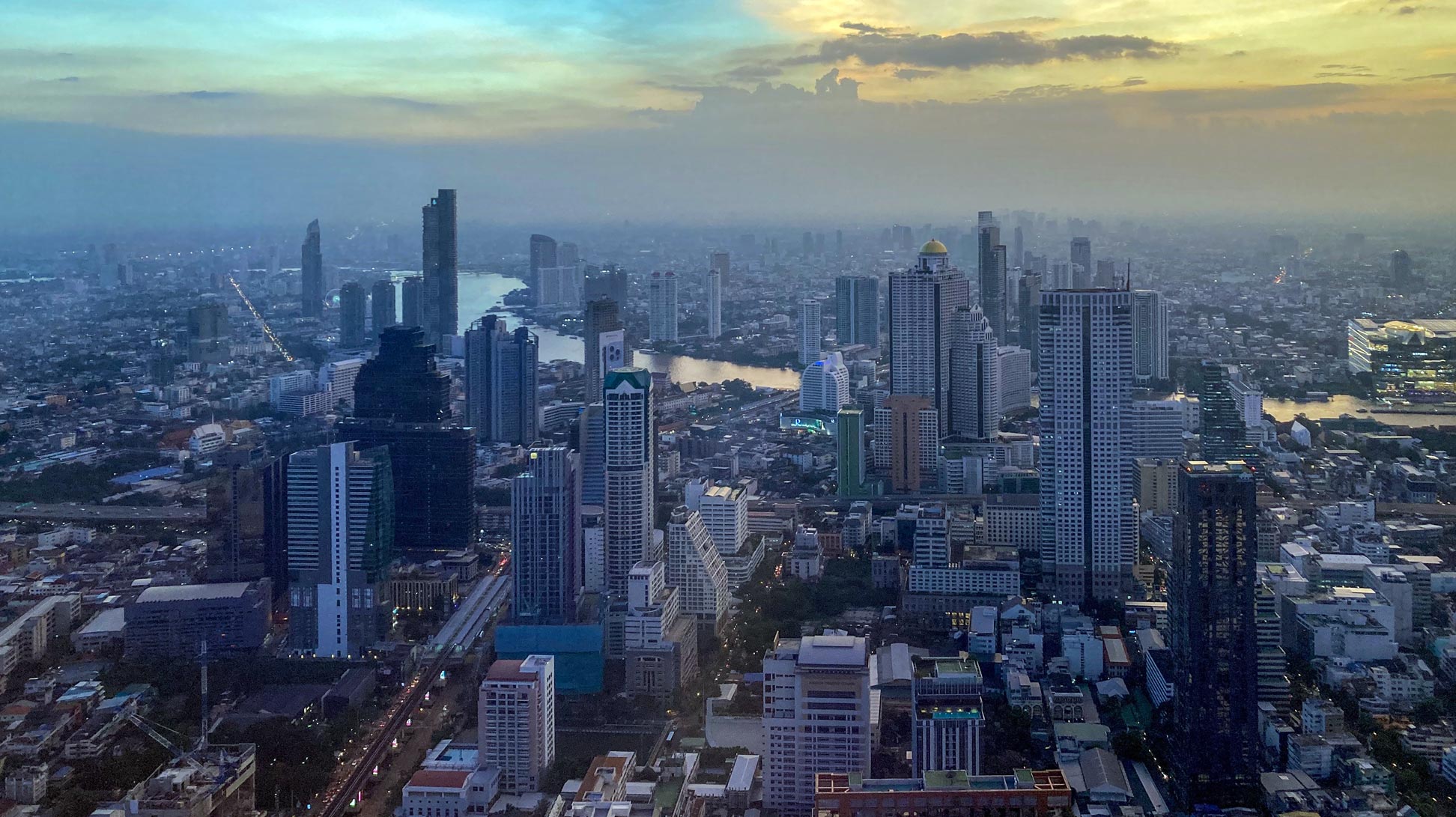
 Bangkok, Thailand's capital, is the country's primate city at the Chao Prayah River. The Bangkok Metropolitan Region (BMR) covers an area of more than 7,000 square kilometers and is home to an estimated 15 million people.
Photo: kk
Bangkok, Thailand's capital, is the country's primate city at the Chao Prayah River. The Bangkok Metropolitan Region (BMR) covers an area of more than 7,000 square kilometers and is home to an estimated 15 million people.
Photo: kk
Thailand has two main river systems, the
Chao Phraya and the
Mekong.
Chao Phraya
The Chao Phraya River is Thailand's most important waterway. It has played a vital role in the country's history, culture, and economy. The river is formed by the confluence of the
Ping and
Nan rivers at
Nakhon Sawan, and flows south for about 372 kilometers, passing through Bangkok before emptying into the
Gulf of Thailand.
The
Ping River is one of the two main headwaters of the Chao Phraya. It has supported agriculture and settlement for centuries. The
Nan River rises in the
Luang Prabang Range, it joins the Ping at
Nakhon Sawan to form the
Chao Phraya.
Mekong
The Mekong is a vast and ancient river that shapes the geography, politics, and cultures of mainland Southeast Asia. Its source lies in central China, and it flows south through several countries. At the
Golden Triangle, the tripoint where the borders of Thailand, Laos, and Myanmar meet, the Mekong begins to form part of Thailand's northeastern border with Laos. From there, it continues south past several Thai provinces. In Thailand, the Mekong contributes to local irrigation, supports small-scale fishing, and plays a role in regional trade and cross-border interaction.
🟪 List of Thailand's 77 provinces.
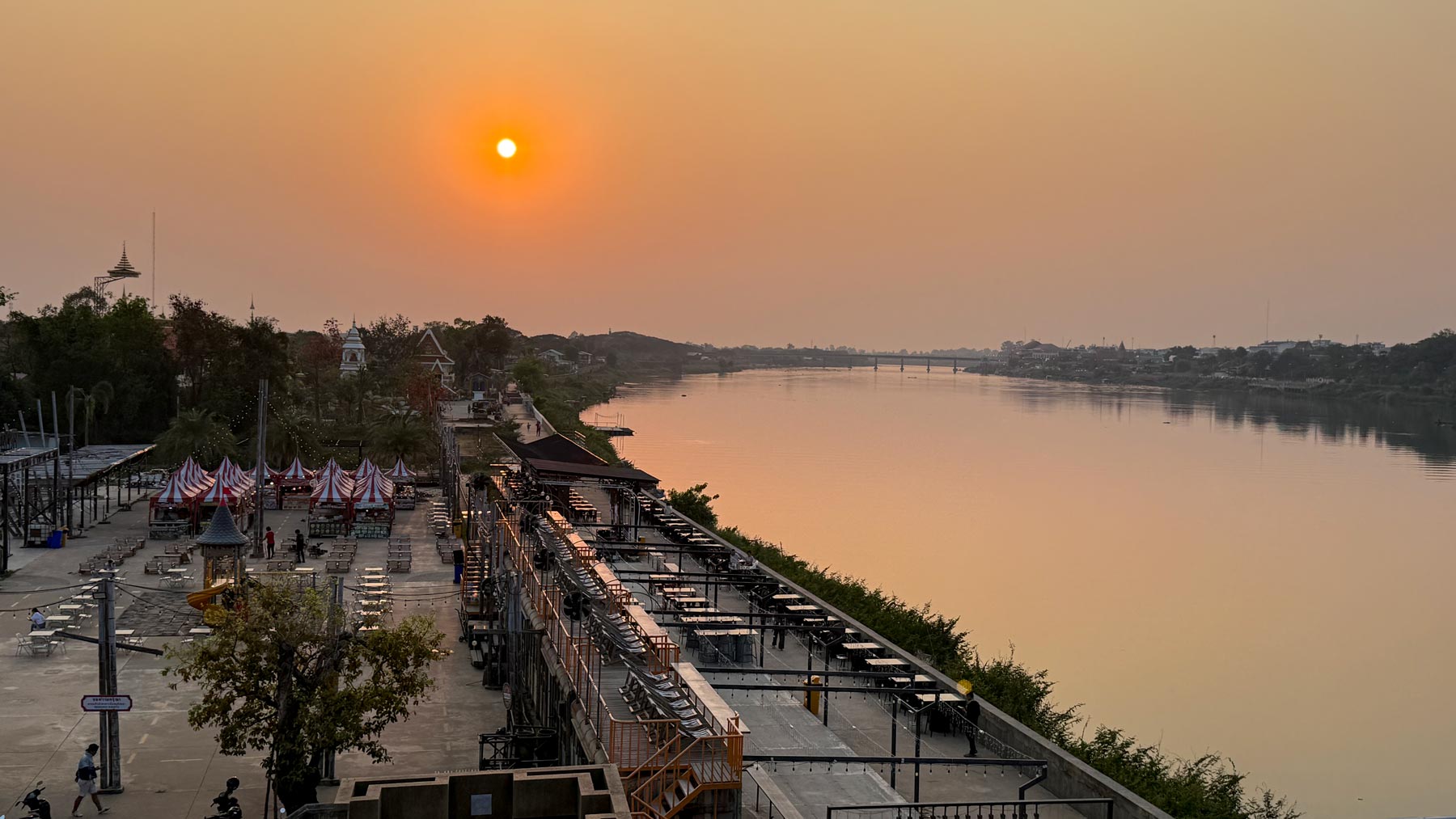 Sunset on the Mun River at Ubon Ratchathani, the capital of the province of the same name. The Mun River is a tributary of the Mekong.
Photo: kk
Sunset on the Mun River at Ubon Ratchathani, the capital of the province of the same name. The Mun River is a tributary of the Mekong.
Photo: kk
Chiang Mai, Lamphun, Lampang, Uttaradit, Phrae, Nan, Phayao, Chiang Rai, Mae Hong Son, Nakhon Sawan, Uthai Thani, Kamphaeng Phet, Tak, Sukhothai, Phitsanulok, Phichit, and Phetchabun.
Northeastern Region
Nakhon Ratchasima , Buri Ram, Surin, Si Sa Ket, Ubon Ratchathani, Yasothon, Chaiyaphum, Amnat Charoen, Bueng Kan, Nong Bua Lam Phu , Khon Kaen, Udon Thani, Loei, Nong Khai, Maha Sarakham, Roi Et, Kalasin, Sakon Nakhon, Nakhon Phanom, and Mukdahan.
Central Region provinces
Samut Prakan, Nonthaburi, Pathum Thani, Phra Nakhon Si Ayutthaya, Ang Thong, Lop Buri, Sing Buri, Chai Nat, Saraburi, Chon Buri, Rayong, Chanthaburi, Trat, Chachoengsao, Prachin Buri, Nakhon Nayok, Sa Kaeo, Ratchaburi, Kanchanaburi, Suphan Buri, Nakhon Pathom, Samut Sakhon, Samut Songkhram, Phetchaburi, and Prachuap Khiri Khan.
Southern Region
Chumphon, Krabi, Nakhon Si Thammarat, Narathiwat, Pattani, Phangnga, Phatthalung, Phuket, Ranong, Satun, Songkhla, Surat Thani, Trang, and Yala.
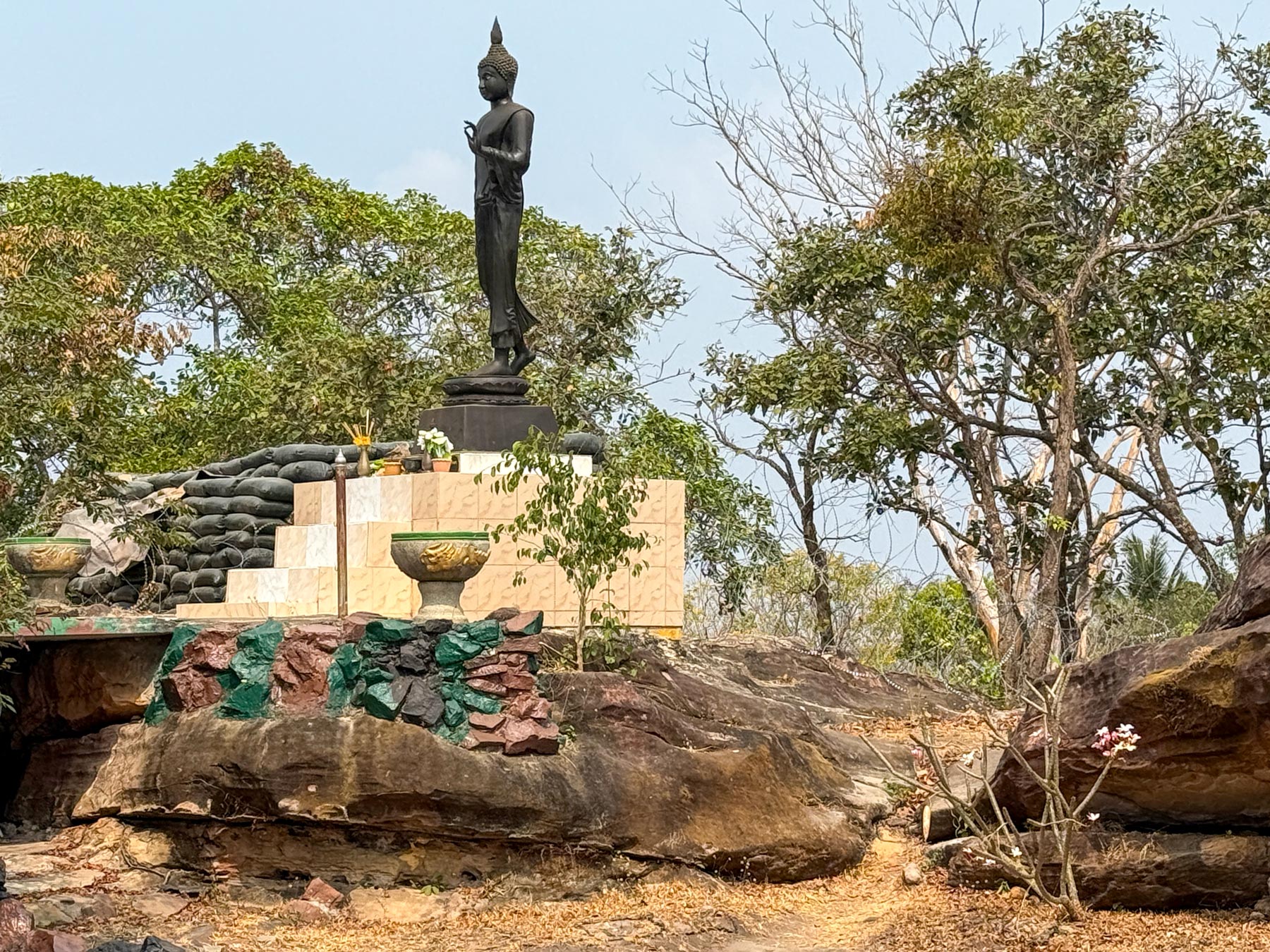 Sandbags, razor wire, and Thai military shelters surround a Buddha statue in the Thai-Cambodian border area near the Temple of Preah Vihear, a UNESCO World Heritage Site located in Cambodia.
Photo: kk
Sandbags, razor wire, and Thai military shelters surround a Buddha statue in the Thai-Cambodian border area near the Temple of Preah Vihear, a UNESCO World Heritage Site located in Cambodia.
Photo: kk
🟧 Borders
Thailand shares borders with
Cambodia (Kingdom of Cambodia),
Laos (Lao PDR),
Malaysia and
Myanmar (Burma).
Cambodia
Thailand's main land border crossing to Cambodia is at
Aranyaprathet—
Poipet, a Cambodian city famous for its casinos.
The Thai-Cambodian border dispute centers on the area around the
Preah Vihear Temple, an ancient
Khmer temple awarded to Cambodia by the
International Court of Justice (ICJ) in 1962. However, Thailand and Cambodia both claim ownership of the surrounding land, especially a 4.6 km² area near the temple.
Tensions have flared multiple times since the 2000s, leading to military standoffs, brief clashes, and evacuations of civilians.
Laos
The main land border crossing between Thailand and Laos is at the
Thai-Lao Friendship Bridge in
Nong Khai, connecting Nong Khai, Thailand, to
Vientiane the capital of Laos.
The Second Thai–Lao Friendship Bridge over the
Mekong connects
Mukdahan Province in Thailand with Savannakhet in Laos.
The
Nakhon Phanom border crossing connects Thailand and Laos via the Third Thai-Lao Friendship Bridge.
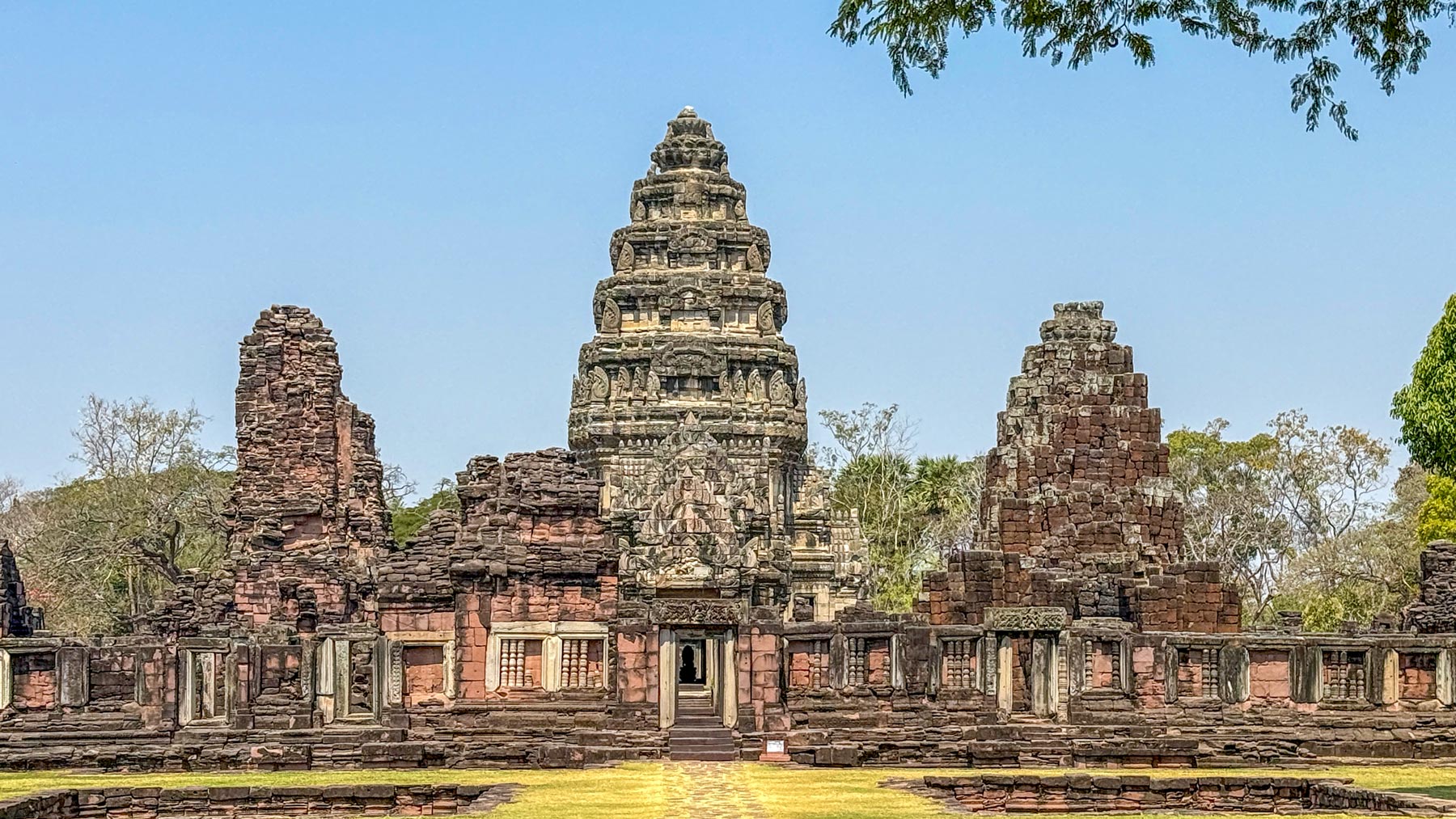 Khmer temple ruins in Phimai Historical Park, Phimai, Nakhon Ratchasima.
Photo: kk
Khmer temple ruins in Phimai Historical Park, Phimai, Nakhon Ratchasima.
Photo: kk
The primary land border crossing between Thailand and Malaysia is at
Padang Besar, which has both a train station and a road crossing.
Thailand–Malaysia Border Tensions
The tension isn't between the tow countries but primarily within southern Thailand, in the deep south provinces:
Pattani,
Yala,
Narathiwat, and parts of
Songkhla, all Thai provinces bordering northern Malaysia. This region was once part of the Malay
Sultanate of Pattani, which was gradually absorbed into Siam (now Thailand) in the early 20th century. The population in the region is predominantly ethnic Malay, Malay-speaking, and Muslim.
Since 2004, a violent insurgency has resurged, involving separatist groups seeking greater autonomy or independence. Attacks include bombings, ambushes, and assassinations, mostly targeting Thai security forces, teachers, and officials. Over 7,000 people have died in the violence.
Myanmar
Thailand's main land border crossings with Myanmar are at
Mae Sot—
Myawaddy, and
Mae Sai—
Tachileik. There is also a less-frequented crossing at
Ranong—
Kawthaung.
The
US  UK Australia
 and
EU countries have issued
travel warnings for all travel to Myanmar. The reason for this, is the ongoing civil war in that country.
Golden Triangle
The Golden Triangle is a border region at the tripoint where the borders of Thailand, Myanmar, and Laos meet. It covers an area of roughly 200,000 km² and is centered at the confluence of the Mekong and Ruak rivers. The Golden Triangle was once infamous as one of the world's largest opium-producing areas, the region has shifted focus since the 1990s, thanks to development efforts by the Thai government and
Royal Projects under
King Bhumibol. Today, the Golden Triangle remains a sensitive border zone but also draws visitors for its striking geography and historic role in regional trade and security.
✈ Airports
The principal
airports of Thailand
(The links open the official airport website.)
✈ Bangkok Suvarnabhumi Airport (
IATA code: BKK)
✈ Bangkok Don Muang Airport (IATA code: DMK)
✈ Chiang Mai International Airport (IATA code: CNX)
✈ Chiang Rai International Airport (IATA code: CEI)
✈ Phuket International Airport (IATA code: HKT)
✈ U-Tapao International Airport (IATA code: UTP)
More Thailand Information
Amazing Thailand
The official website of Tourism Authority of Thailand.
Thailand Tourism Directory
Tourist information by the Ministry of Tourism and Sports Thailand.
Thailand NOW
Thailand NOW offers information on all aspects of Thai life.
Bangkok Post
English-language newspaper with news from Thailand.
The Nation
English-language newspaper Thailand related.




 Thai Flag
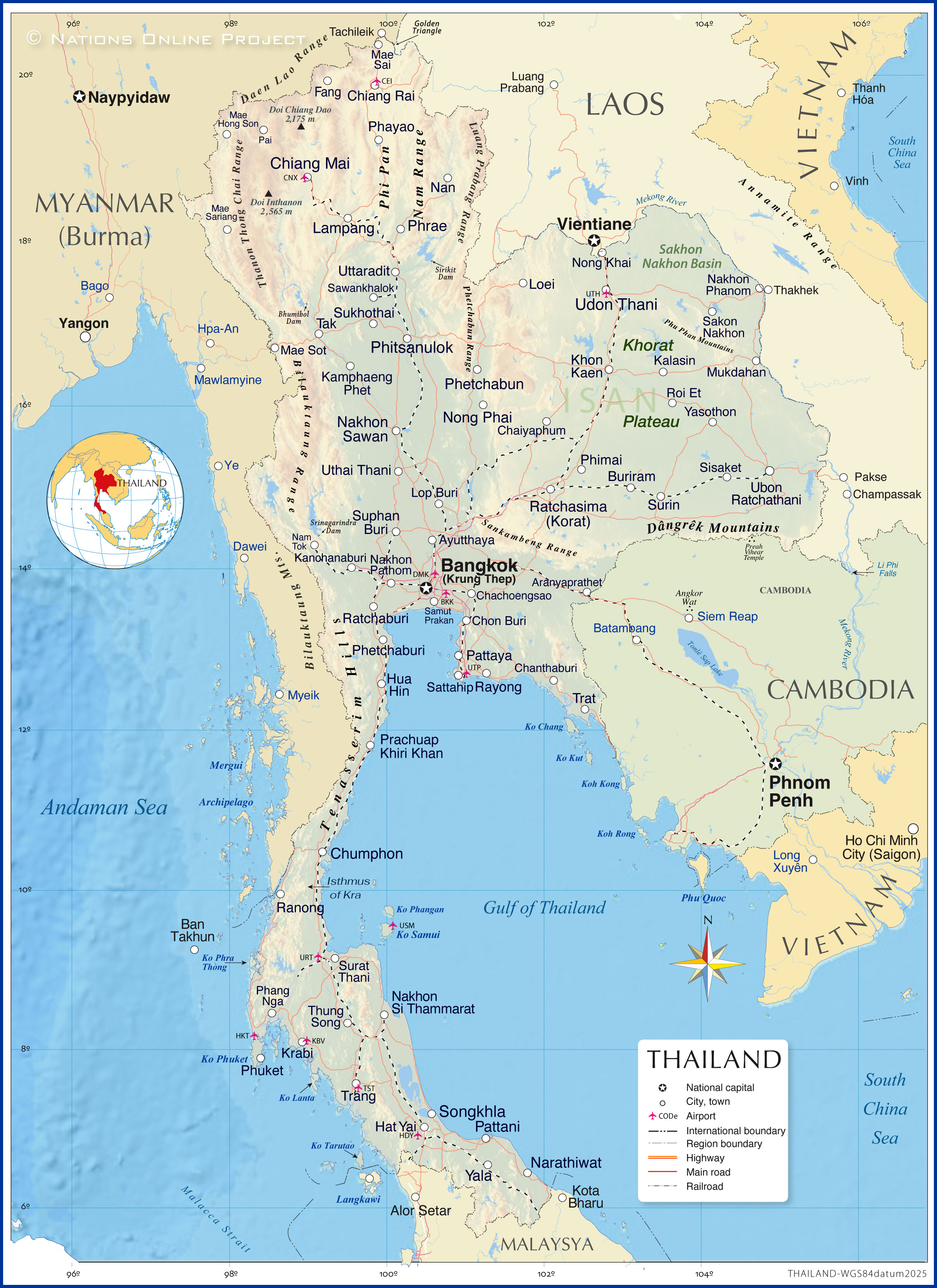 Map of Thailand
 You are free to use the above map for educational and similar purposes; if you publish it online or in print, you need to credit Nations Online Project as the source.
 Thai Regions