More about Syria
MIDDLE EAST
Syrian civil war situation map
Military situation as of 15 July 2025
.svg) Latest map of the Syrian civil war, which has been ongoing since 2011.
Latest map of the Syrian civil war, which has been ongoing since 2011.
The map shows the shifting territories of the various forces warring in the country and beyond.
Legend
Syrian transitional government

Syrian Armed Forces

Syrian Free Army

Turkish occupation and ex-Syrian National Army

Syrian Democratic Forces and Deir ez-Zor defectors

Suwayda Druze factions
Foreign occupations

Israeli occupation and invasion

American occupation and Syrian Free Army

Russian occupation and Assadist insurgent presence.
Map sources: Wikipedia; other situtaion map at liveuamap.
Syria 2025: A Fragmented Landscape of Power and Influence
Nearly four years after the fall of the Assad regime, Syria remains divided, contested, and shaped by a complex web of domestic factions and foreign forces.
Syrian transitional government
Syrian Armed Forces (Government-Aligned) The core of Syria's transitional government, under
President Ahmed al‑Sharaa, controls much of western Syria, centered in Damascus, Homs, and the coastal provinces. They are rebuilding a national army but continue to rely heavily on former HTS fighters and allied Islamist brigades. While seeking legitimacy, their influence is weakest in peripheral regions and among minorities.
Free Syrian Army (FSA)
Reconstituted under the transitional process, the FSA is now a nominal umbrella for various rebel factions allied with the new government. However, its cohesion is weak. Some former FSA commanders have joined the new army, while others remain semi-autonomous or aligned with Turkish-backed forces.
Turkish Occupation & ex-Syrian National Army Turkey maintains military control over a broad strip of northern Syria, including Afrin, al-Bab, and parts of Idlib and Hasakah. This area is largely governed by the Syrian National Army (SNA)—a coalition of former rebels backed and trained by Ankara. The SNA remains deeply fragmented and accused of human rights violations. Turkish forces provide security and political guidance but face local resistance.
Syrian Democratic Forces (SDF)
Dominated by the
Kurdish YPG, the SDF controls large parts of northeast Syria, especially Hasakah and parts of Raqqa and Deir ez-Zor. Tensions remain high between the SDF and both the transitional government and Arab tribes—especially as defectors from the
Deir ez-Zor Arab tribal militias demand greater autonomy and resource control.
Suwayda Druze Factions
In the Suwayda region, Druze militias such as Rijal al-Karama have carved out semi-autonomous control, resisting both Damascus and Bedouin encroachment. Following deadly clashes in July 2025, a U.S.-brokered ceasefire has restored relative calm. However, local Druze leaders remain wary of full reintegration into the central government's orbit.
Intense sectarian clashes erupted mid-July 2025 in the
Druze-majority
Suwayda region between Druze militias and
Sunni Bedouin groups. Hundreds of casualties have been reported.
Foreign Military Presence
Israel remains deeply involved in Syria's conflict—especially in the southwest and along the
Golan Heights. Israel retains full control over the Golan Heights, which it annexed in 1981.
The
Israeli air force regularly carry out so-called precision airstrikes on targets linked to Iran, particularly in Syria: Weapons depots, missile shipments, and drone bases operated by
Iranian Revolutionary Guard Corps (IRGC) and Hezbollah, Sites near Damascus, Homs, and the
Al-Qusayr corridor connecting Lebanon to Syria.
The
United States maintains a limited military presence in eastern Syria, primarily around al-Tanf and Deir ez-Zor, to support the SDF and counter Iranian influence.
Russia
Following Assad's fall, Russia retained air assets at
Khmeimim Air Base, but its influence has waned. Most Russian troops have been redeployed to other theaters.
History
Since March 2011, fighting in Syria has killed between 300,000 to 600,000 people (estimates are difficult).
The Syrian civil war has led to one of the most severe displacement crises globally. As of December 2024, approximately 6.8 million Syrians are internally displaced within the country, and over 5 million have sought refuge abroad, primarily in neighboring countries such as Turkey, Lebanon, and Jordan.
[UNHCR]
The civil unrest in Syria, was eventually triggered by a wider wave of the
2011 Arab Spring protests; it grew out of discontent with the authoritarian Syrian regime and escalated to an armed conflict.
Syrian Border Crossings
Syria-Iraq
Al-Bukamal – Al-Qa'im: Connects Deir ez-Zor Governorate in Syria with Al Anbar Governorate in Iraq. A significant crossing for trade and movement. (recently closed by Iraq; Dec 2024)
Rabia – Al-Yarubiyah: Connects northeastern Syria with northern Iraq, near the Kurdistan Region.
Syria-Turkey
Bab al-Hawa – Cilvegözü: Connects Idlib Governorate in Syria with Hatay Province in Turkey. A key crossing for aid and goods.
al-Salameh – Öncüpınar (Bab al-Salameh Border Crossing)
: Connects northern Aleppo with Turkey's Kilis Province.
Tell Abyad – Akçakale: Connects the Raqqa Governorate with the Şanlıurfa Province in Turkey.
Jarabulus – Karkamış (Carablus): Connects Aleppo Governorate with Gaziantep Province in Turkey.
Syria-Jordan
Jaber – Nassib: A vital crossing connecting southern Syria with northern Jordan, near Daraa.
Ramtha – Daraa (Ar Ramtha Border Crossing): An additional crossing linking Daraa Governorate with the city of Ramtha in Jordan.
Syria-Lebanon
Masnaa – Al-Masnaa: A main crossing on the Beirut-Damascus Highway, linking Syria with Lebanon.
Al-Arida – Arida: Connects Tartus Governorate with northern Lebanon. Al-Dabousiyah: Another crossing connecting Homs Governorate with northern Lebanon.
Syria-Israel
Quneitra Crossing:
The Quneitra Crossing, located in the largely destroyed and abandoned capital of the Quneitra Governorate, serves as a key juncture between Syria and the Israeli-occupied Golan Heights. Historically, it has been utilized for limited civilian crossings, humanitarian aid, and the movement of UN personnel within the buffer zone established by the 1974 disengagement agreement.
Cities in Syria
The Map shows the location of following cities and towns of Syria:
Major cities
Aleppo, Al Hasakah, Damascus (capital city), Daraa, Darayya, Deir ez-Zor, Douma, Raqqa, Hama, Homs, Idlib, Latakia, Manbij, Palmyra, Qamishli, Ra's al 'Ayn, Suwayda (As-Suwayda), Tartus.
Syrian cities
A'zaz, Abu Kamal (Al Bukamal), Al Bab, Al Hasakah, Al Ladhiqiyah (Latakia), Al Qamishli, Al Qaryatayn, Al Qusayr, Al'Asharah, An Nabk, Ar Raqqah, Ar Rastan, Ariha, As Sa'an, As Sukhnah, As Suwar, As Suwayda', Ash Shaddadah, At Tanf, At Tibni, Az Zabadani, Baniyas, Busayrah, Busra ash Sham, Damascus, Dara (Daraa), Deir ez-Zor (Dayr az Zawr), Dumah, Halab (Aleppo), Hama, Hims (Homs), Idlib, Jarabulus, Khan Shaykhun, Ma'arrat an Nu'man, Madinat ath Thawrah, Manbij, Maydan Ikbiz, Oubur al Bid, Quneitra (Al Qunaytirah), Ra's al 'Ayn, Sab' Abar, Salahiyah, Tadmur (Palmyra), Talkalakh, Tall al Abyad, Tall Kujik, Tall Tamir, Tartus, and Tiyas.
Advertisements:




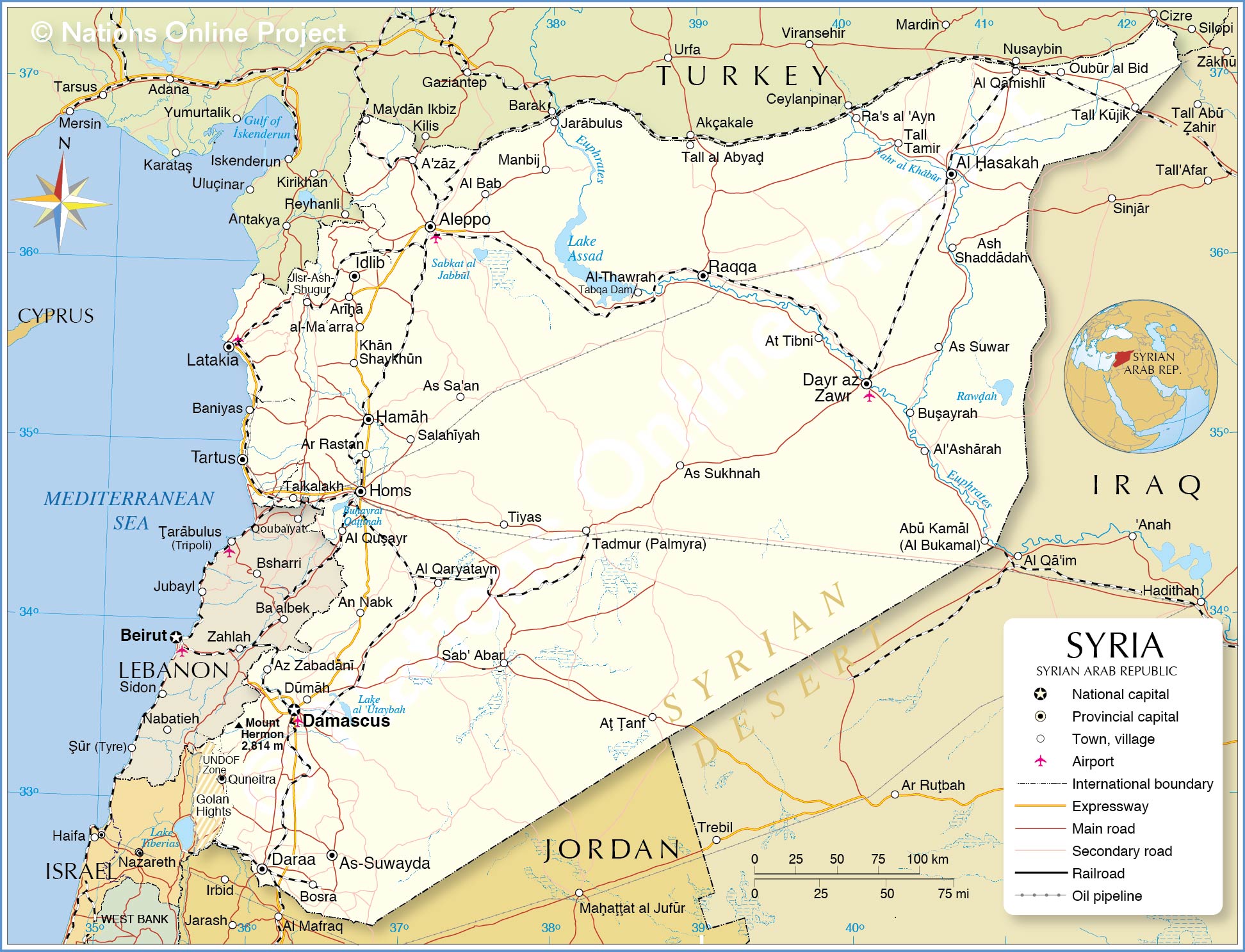
 You are free to use the above map for educational and similar purposes; if publishing, please credit Nations Online Project as the source.