About Saudi Arabia
The map shows Saudi Arabia, officially the Kingdom of Saudi Arabia, a desert country in southwestern Asia (Middle East) that occupies most of the
Arabian Peninsula.
The kingdom is bounded by the Gulf of Aqaba and the
Red Sea in the west and the Persian Gulf in the east. Border countries are
Iraq,
Jordan,
Kuwait,
Oman,
Qatar,
United Arab Emirates, and
Yemen. Saudi Arabia shares maritime boundaries with
Egypt,
Sudan, and
Eritrea in the Red Sea, and with
Iran, and
Bahrain in the Persian Gulf.
The country is the largest Arab state with a
land area of more than two million km²; compared, the sheikdom is about four times the size of
France, or somewhat larger than one quarter the size of the contiguous United States.
Saudi Arabia has a
population of 34.8 million people (in 2020); more than 10 million people are expatriates, mainly from Asia and the Middle East.
Saudi Arabia is the homeland of Arab Bedouins and the Arabian language, the historic birthplace of Islam and the Arab-Islamic culture which originated in the towns of
Mecca and Medina at the beginning of the 7th century.
The country's capital and largest city is
Riyadh. Other major towns are Jiddah,
Ta'if (At Taif), Dammam, Buraydah, and Al Khobar, part of the Dammam metropolitan area. Spoken
language is Arabic.
More about Saudi Arabia
 Al-Masjid Al-Ḥarām, the Great Mosque of Mecca. Located within the largest mosque in the world is the Kaaba, the holy shrine of Islam. Abraj Al Bait in background, a megatall hotel complex of seven skyscrapers.
Photo: neo saed
The
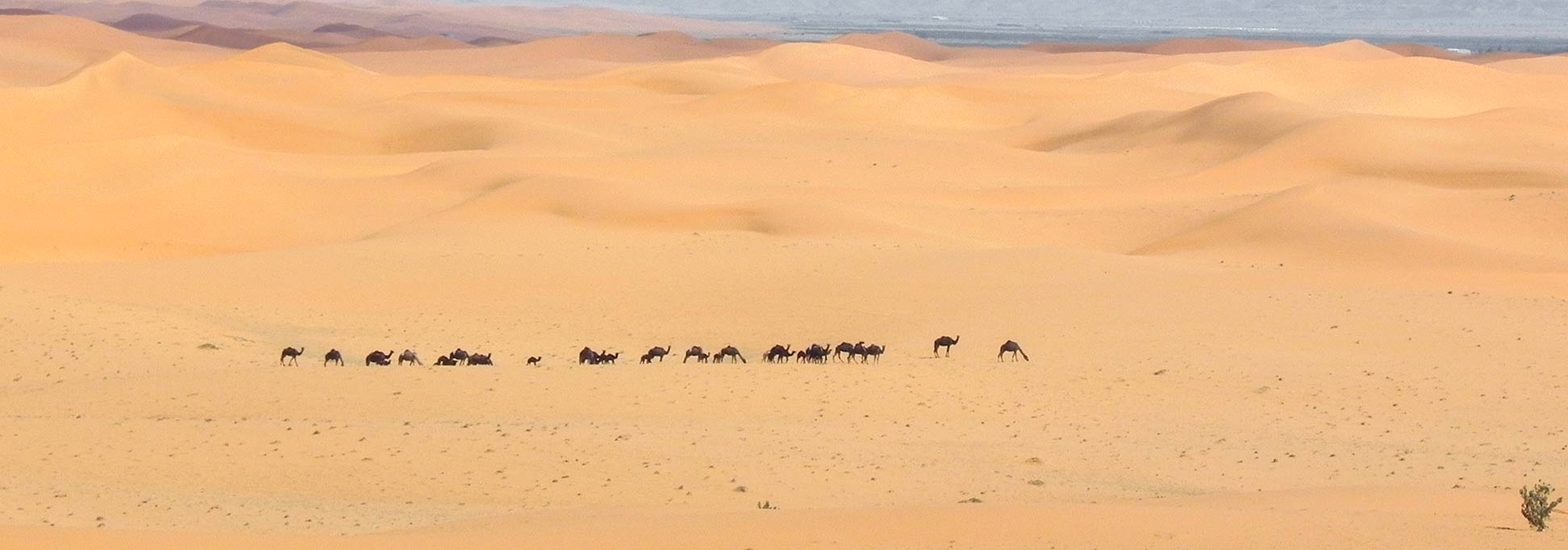
Arabian Desert covers large parts of the country's landscape. The vast area consists of a number of interconnected desert regions including the An Nafud in the north, and the Rub' al Khali ("the Empty Quarter") in the southern part of the country. The Rub' al Khali is one of the world's largest contiguous sand deserts.
The coastal plain in western Saudi Arabia along the Red Sea is known as the
Tihamah, the east of the plain is dominated by the escarpments of two mountain ranges, the Hejaz and the Asir mountain range, separated by a gap in the area of Mecca. The highest point of Saudi Arabia is
Jabal Sawda, the peak of about 3,000 m is located in the Abha region in the Asir mountains in the southwestern corner of the sheikdom. The one hundred kilometers wide strip of coastal plains and the western mountain ranges is known as the
Hejaz ('the Barrier'). The Hejaz separates the coastal area from the
Najd, the central region of Saudi Arabia. The Najd is bounded to the east by the historical region of Eastern Arabia, and in the north by the Syrian Desert.
There are no rivers or bodies of water in the country, only ancient river channels, now buried by the seas of sand. There are wadis, i.e. valleys or river courses, which often carry water temporarily only after heavy or prolonged rainfall. Nonrenewable fossil water from aquifers and underground rivers, water from seasonal floods, and desalinated saltwater are used for human consumption and irrigation.
Climate
Saudi Arabia has a predominantly hot and dry environment. The continental climate in the interior of the country features considerable temperature differences, especially between day and night. In summer, maximum temperatures of 50° C are possible during the day, in winter, the freezing point can be reached at night. The average annual temperature is 28° C.
Administrative regions
Saudi Arabia is divided into 13 administrative regions.
Saudi Arabia's administrative divisions are officially called "provinces" (in Arabic,
minṭaqah)
The provinces are (region capital in parenteses):
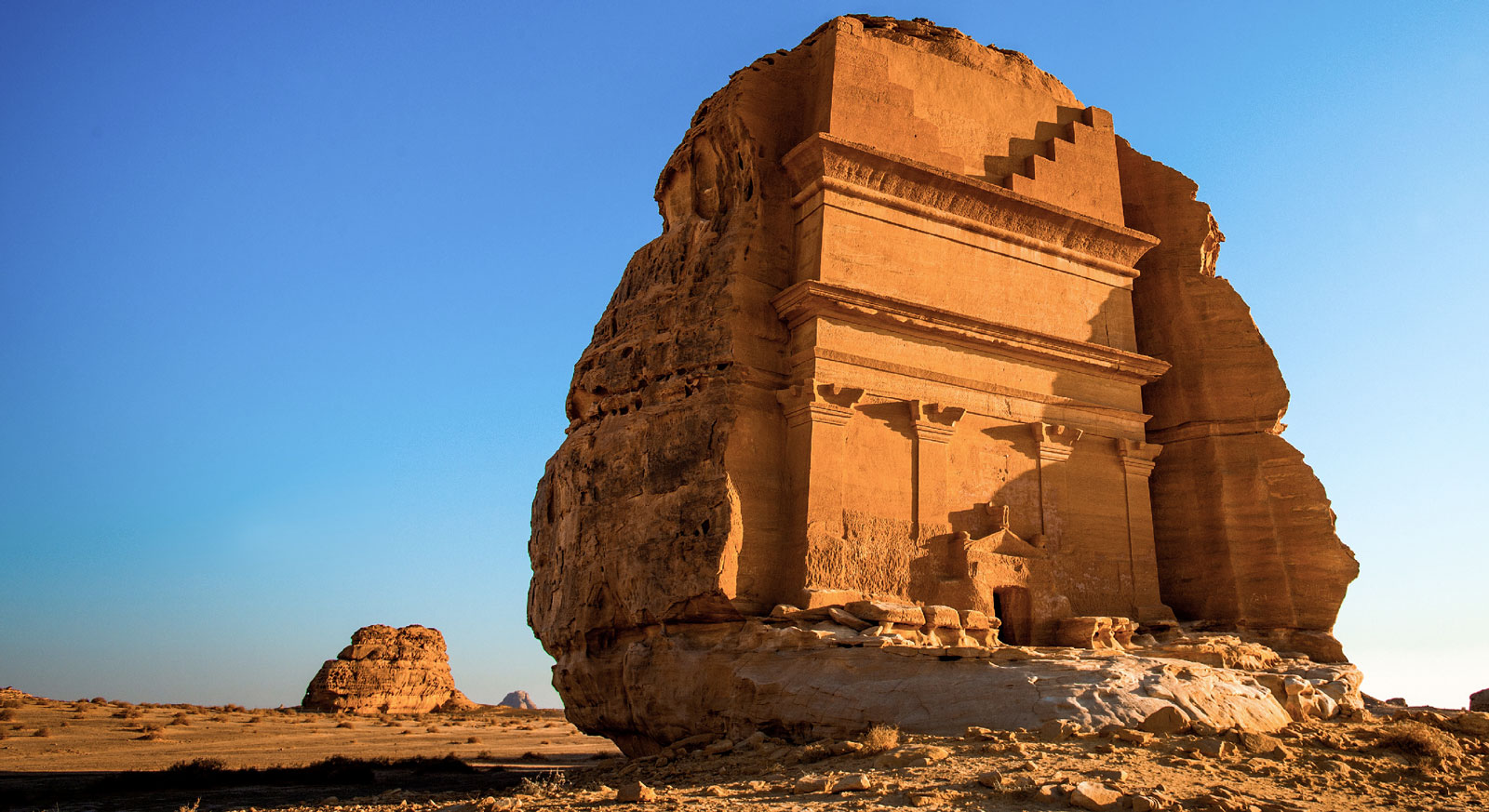 Qaṣr al-Farīd, the largest tomb in Hegra (al-Hijr / Madā ͐ in Ṣāliḥ), an archaeological site located in the area of Al-'Ula in Medina Province in the Hejaz region of Saudi Arabia. Hegra Archaeological Site is a UNESCO World Heritage Site.
Photo: Ali Lajami
- 1. Al-Bahah Province (Al-Bahah)
A small mountainous region known for its cool climate and green landscapes. Al-Bahah is a popular summer retreat and home to traditional villages like Dhee Ayn, built with white marble.
- 2. Al Jawf Province (Sakakah)
Situated in northern Saudi Arabia, Al Jawf is known for its olive farms and ancient ruins like Marid Castle. Sakakah serves as the administrative center and features a mix of modernity and heritage.
- 3. Al-Qassim Province (Buraidah)
A central region famous for its date production, especially the annual Date Festival. Buraidah is the cultural and economic hub, featuring traditional souks and museums.
- 4. 'Asir Province (Abha)
Located in the southwestern highlands, 'Asir boasts a temperate climate and lush greenery. Abha, the capital, is known for its unique architecture, traditional markets, and as a gateway to the Asir National Park.
- 5. Eastern Province (Dammam)
The largest province in Saudi Arabia, rich in oil reserves. Dammam is a bustling city and serves as a major hub for industry, commerce, and transportation, with a prominent coastline along the Arabian Gulf.
- 6. Ha'il Region (Ha'il)
Known for its desert landscapes and rich history, Ha'il is a cultural center with ancient rock art and forts like Qishlah Fortress. It also hosts festivals celebrating Bedouin traditions.
- 7. Jizan Province (Jizan) Situated in the southwest near the Red Sea, Jizan features fertile agricultural land and a tropical climate. The Farasan Islands, known for their biodiversity and marine life, are part of this region.
- 8. Madinah Province (Medina)
This region holds religious significance as the site of Medina, the second holiest city in Islam and the Prophet Muhammad's burial place. It is also known for date farms and historical Islamic landmarks.
- 9. Makkah Province (Mecca)
Home to Mecca, the holiest city in Islam and the site of the Kaaba in Masjid al-Haram. Millions of Muslims visit annually for the Hajj pilgrimage. The region also includes coastal cities like Jeddah.
- 10. Najran Province (Najran)
Located near the Yemeni border, Najran is known for its rich history, including ancient inscriptions and ruins. It is also an agricultural hub with a focus on cultivating dates and fruits.
- 11. Northern Borders Region ('Ar'ar)
This sparsely populated region in the far north features desert plains and is known for its role in connecting Saudi Arabia to Iraq. 'Ar'ar is the administrative capital.
- 12. Riyadh Province (Riyadh)
The central region and home to Riyadh, the capital city of Saudi Arabia. It is a thriving metropolitan area with modern skyscrapers, cultural landmarks, and economic importance as the political hub.
- 13. Tabuk Province (Tabuk)
A northwestern region near Jordan, Tabuk is known for its historical significance as a route for ancient trade caravans. It has impressive desert landscapes and modern development projects like NEOM.




 You are free to use the above map for educational and non-profit purposes; if you publish it online or in print, you need to credit Nations Online Project as the source.