More about the United Arab Emirates
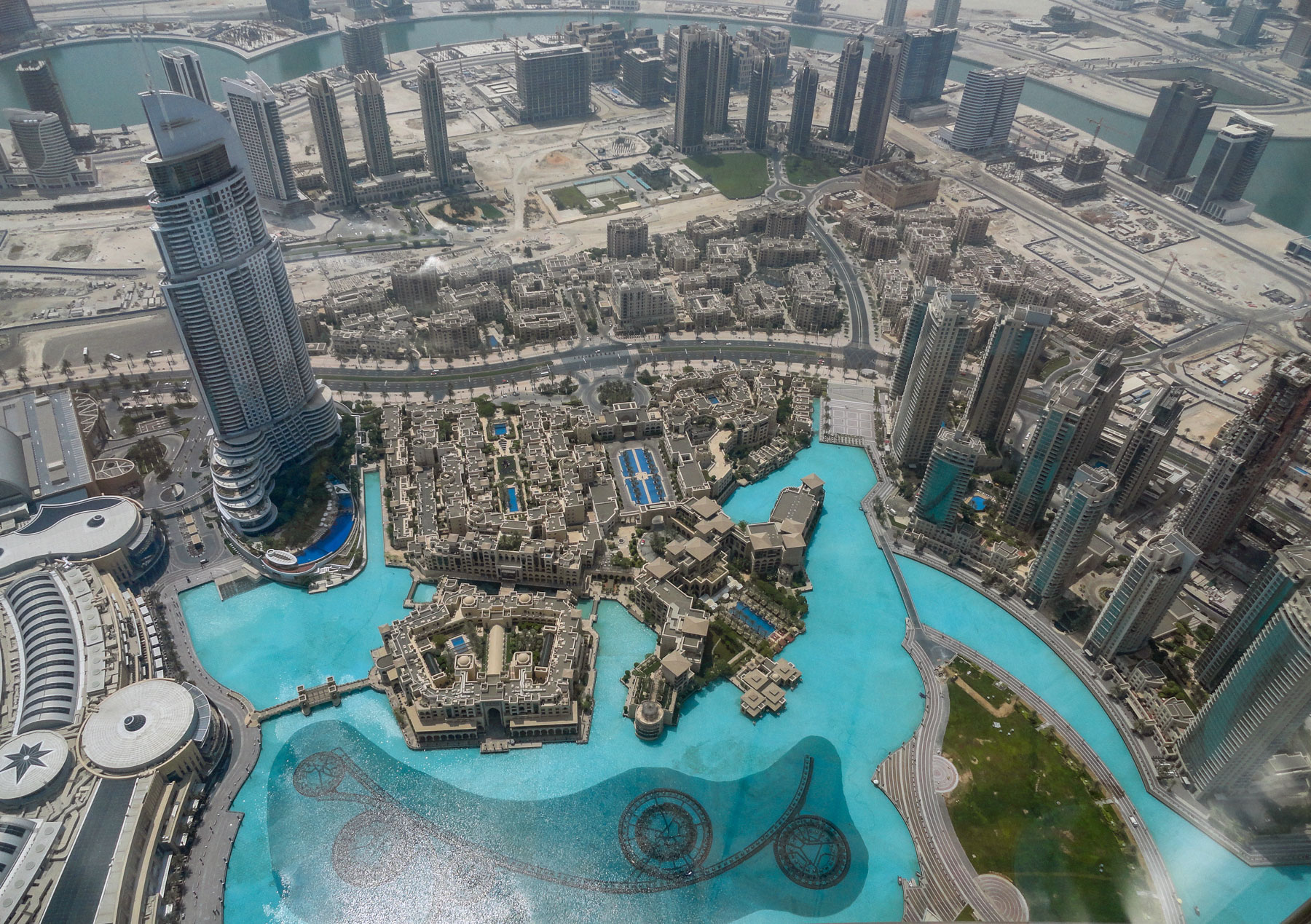 Dubai, view of Khalifa Lake from Burj Khalifa, the world's tallest building. In the lake are Souk Al Bahar, a shopping mall (left), and Palace Downtown, a 5-star hotel (right). The Dubai Mall, the second-largest shopping and entertainment center in the world, can be seen on the left side of the picture. The tower in the picture is the 5-star hotel Address Downtown
.
Photo: Fabio Achilli
The coastal region of today's UAE was known for a long time as the
Pirate Coast. The seafaring inhabitants made a living by pirating trade vessels in the area.
The loose federation of tribal sheikdoms came under British administration in the mid-19th century. The federation was known as the Trucial States until 1971.
The UAE came into existence with independence from the UK in December 1971. The six emirates that formed a federation were: Abu Dhabi, Dubai, Sharjah, Ajman, Umm Al-Quwain, and Fujairah. Ras Al-Khaimah joined the alliance in 1972.
Geography of the United Arab Emirates
The country is dominated by an arid landscape of vast gravel plains and sprawling desert dunes. Amid this inhospitable environment, pockets of greenery emerge in the form of oases, the most notable being the
Liwa Oasis. The oases region is located in southern UAE, in the
Rub' al Khali, also known as the
Empty Quarter, the largest continuous sand desert in the world.
The coastline of the Emirates features a unique ecological zone, marshes, also called
sabkhas. Low-lying saline flats, interspersed with lagoons, intertidal mudflats, and mangrove swamps. The ecoregion sustains a surprising diversity of flora and fauna in an otherwise dry environment.
In contrast to the flat deserts and coastal marshes, the northeastern part of the UAE rises into the rugged terrain of the
Hajar Mountains, a mountain range shared by the UAE and Oman. Among its peaks is
Jabal Yibir, standing at 1,527 m (5,010 ft), and
Jabal ar Raḩraḩ, part of the
Jebel Jais range, which at 1,892 m (6,207 ft) is the highest peak in the UAE. Jebel Jais also hosts Oman's highest point on another summit.
Administrative Divisions of the UAE
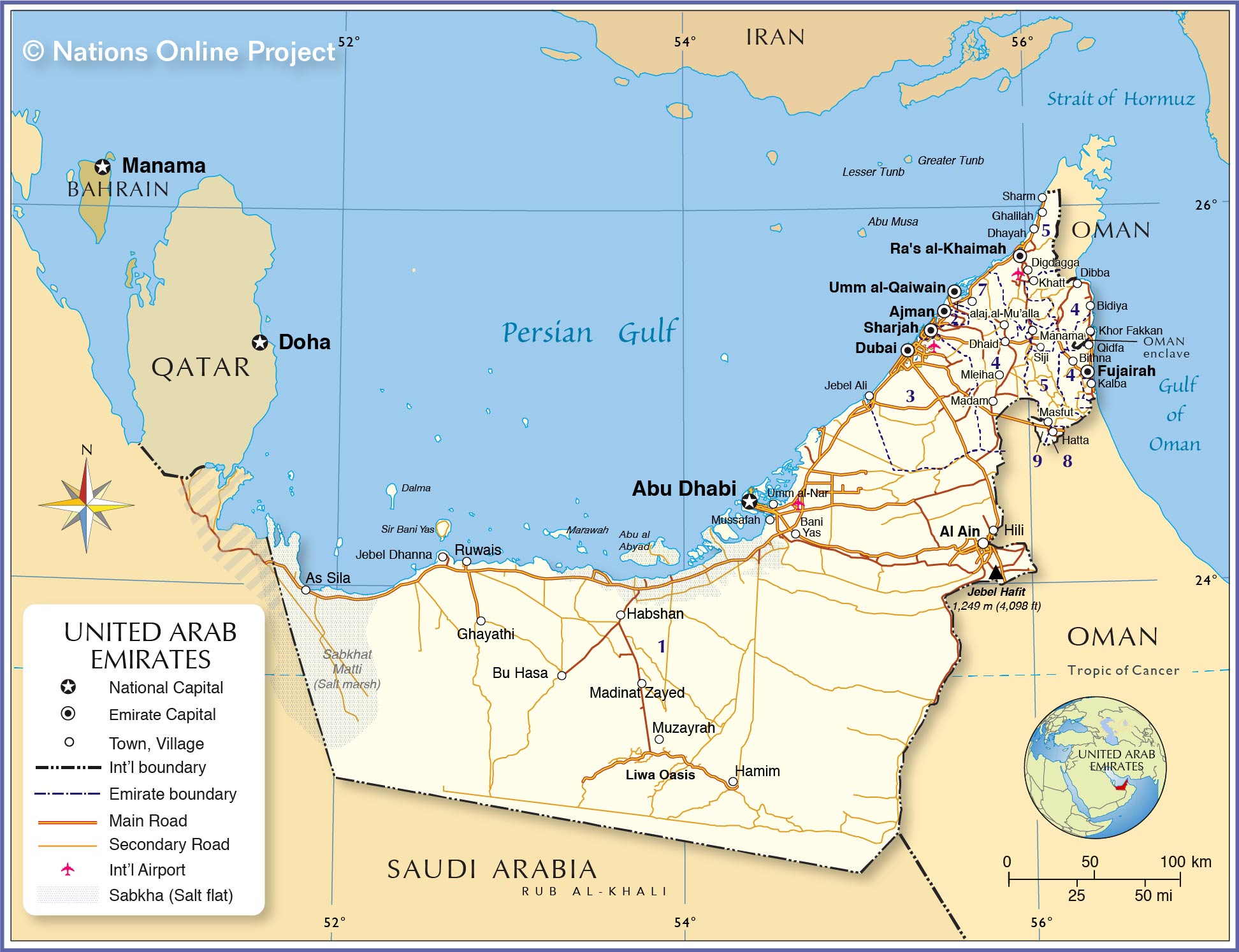
The United Arab Emirates is a federation of seven emirates; their capitals have the same name as the emirate (see on the map).
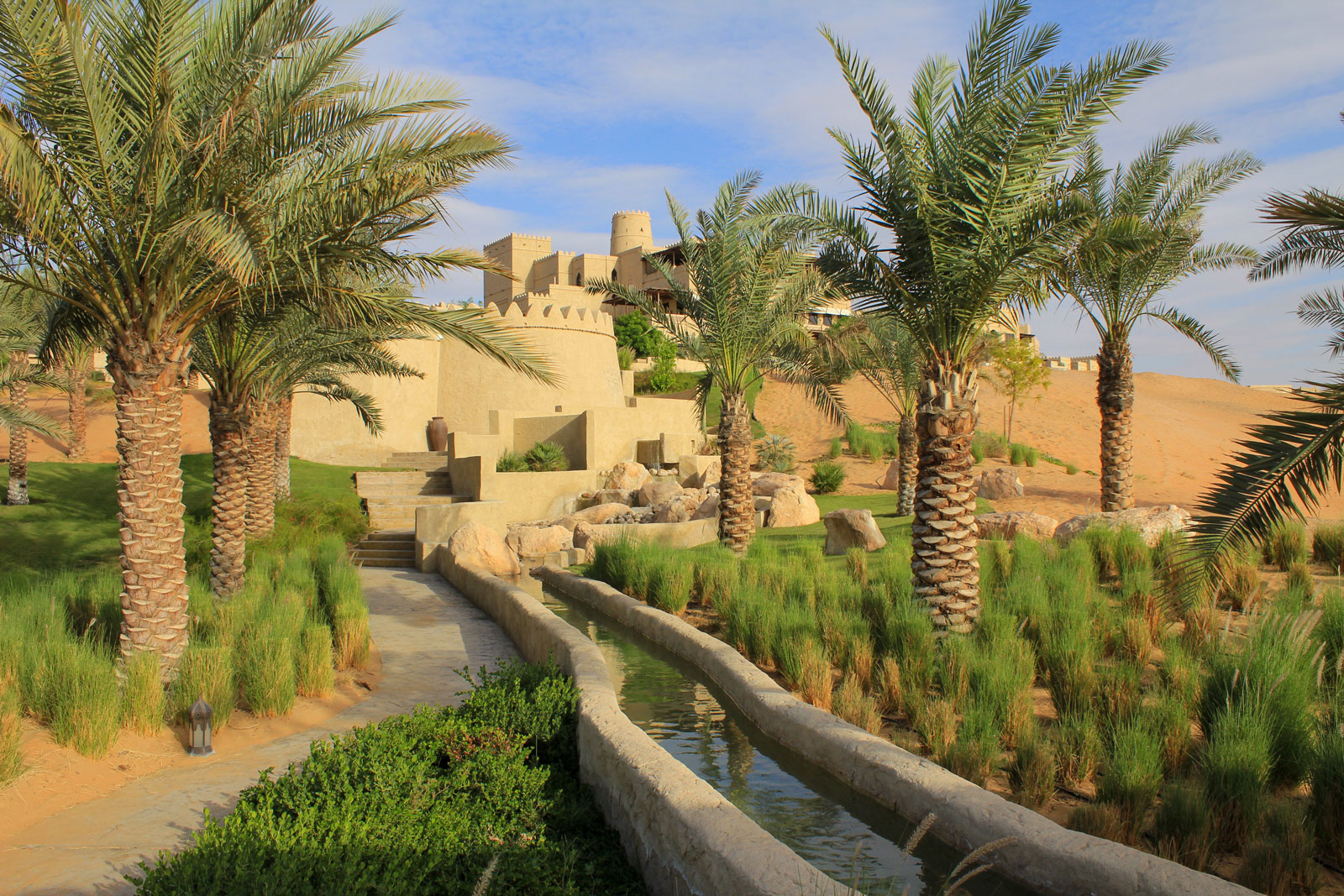 A falaj, an ancient irrigation channel in Qasr Al Sarab ("Mirage Palace"), a luxurious resort in the Liwa Oasis
.
Photo: Xiaotong Gao
The largest emirate, covering approximately 67,340 km², Abu Dhabi serves as the nation's capital. It's renowned for its vast deserts, rich oil reserves, and landmarks like the
Sheikh Zayed Grand Mosque.
2. Ajman
The smallest emirate, Ajman, encompasses about 259 square kilometers. Despite its size, it offers beautiful beaches and a growing economy.
3. Dubai
Spanning about 3,885 km², Dubai is the most populous emirate. It is famous for its ultramodern architecture and bustling shopping scenes. The emirate offers state-of-the-art attractions such as the
Burj Khalifa, the world's tallest structure, and
Palm Jumeirah, a palm-shaped artificial island.
4. Fujairah
Located on the east coast, Fujairah covers approximately 1,165 km². It is known for its mountainous terrain and access to the
Gulf of Oman, making it a hub for shipping and trade.
5. Ras al-Khaimah
The emirate covers approximately 1,684 km² and is renowned for its archaeological sites, picturesque mountains, and
Jebel Jais, home to
Jabal ar Raḩraḩ, the UAE's
highest point at 1,691 m (5,548 ft).
 Musandam Peninsula. View from the highest point in the UAE, the Jabal ar Raḩraḩ mountain range, showing Wadi Naqal, Wadi Sal, and Wadi Haqil. The urban sprawl in the background is Rams, a suburb of Ras Al-Khaimah, and the Persian Gulf Coast.
Photo: Ciorraga
Musandam Peninsula. View from the highest point in the UAE, the Jabal ar Raḩraḩ mountain range, showing Wadi Naqal, Wadi Sal, and Wadi Haqil. The urban sprawl in the background is Rams, a suburb of Ras Al-Khaimah, and the Persian Gulf Coast.
Photo: Ciorraga
Covering around 2,590 km², Sharjah is known for its commitment to arts and culture, housing many museums and cultural centers. It's the only emirate with coastlines on both the
Persian Gulf and the
Gulf of Oman.
7. Umm al-Quwain
Covering roughly 777 km², Umm al-Quwain is the least populous emirate. It offers a more laid-back atmosphere with attractions like the
Dreamland Aqua Park and rich mangrove forests.
Areas under joint control
Three emirates have areas with territorial arrangements. These agreements are often based on historical agreements, geographical overlaps, shared resources, tribal affiliations.
Emirates with shared control are:
(8) Fujairah Emirate and Sharjah Emirate.
(9)
Oman (a sovereign country) and Ajman Emirate.
Disputed Areas
Little Tunb, Greater Tunb, and
Abu Musa are three small islands in the
Persian Gulf. Their strategic location near vital shipping routes makes them important. The islands are located near the entrance to the
Strait of Hormuz, one of the most critical chokepoints for global energy trade. The islands are under Iranian administration but are claimed by the UAE.


 You are free to use the above map for educational and non-profit purposes; if you publish it online or in print, you need to credit Nations Online Project as the source.